Mission Statement

The Rant's mission is to offer information that is useful in business administration, economics, finance, accounting, and everyday life. The mission of the People of God is to be salt of the earth and light of the world. This people is "a most sure seed of unity, hope, and salvation for the whole human race." Its destiny "is the Kingdom of God which has been begun by God himself on earth and which must be further extended until it has been brought to perfection by him at the end of time."

Tuesday, July 19, 2016

Analysis of "Persuasion in the Media Age" (part 7)


Media Defined

The product of the interaction between media sources, channels, content and audience is called media. The term refers to the web of sources, channels and content. It includes broadcast signals, media personalities and the words and images of media content. This definition is important. People make three mistakes in assessing media. First, they use the word media to refer to any or all of the dimensions just listedobscuring exactly what it refers to. Second, they use the term to refer to a singular and monolithic set of people, channels and effects as in, "Media has an influence on how we relate to the world." Not only does this statement fail to designate one aspect of media, but it views media as one body acting alone. In fact, there are hundreds of media organizations which produce thousands of media messages transmitted through several media channels. To reinforce this idea, we use media in the plural. Third, people tend to view media organizations as nameless and faceless entities that create programming based solely on economic or political factors. We must keep in mind that it is individuals working within organizations and responding to corporate pressures - who make decisions concerning media content. We must also realize that there are artistic elements involved in the creation of media content and that individuals, not machines, create art.


Assumptions About Media

With this definition in mind, let us look at three assumptions about media:
  1. Media persuade us.
  2. Media sources, channels and content present us with mediated realities.
  3. Media sources are profit making businesses.


First, media sources and content persuade us by creating knowledge about products and people and their place in our culture. We purchase cars, toasters cereals and other consumer goods and services based on the words and images selected for us by advertising professionals. We select political leaders based on the impression we get of them through various media channels. We learn what is important in our culture from media content.

Second, media sources, channels and content present us with mediated realities. The pictures we have in our heads of people, and of corporations are not usually based on our real experiences with them. Instead, these pictures are formed through our interaction with media images. Some theorists argue that the symbols we use create reality. You may never have been to Fargo North Dakota. However, you have probably heard about Fargo and the Upper Midwest in the media. You may have seen news reports of terrible snowstorms in the area, or you may have seen the film Fargo, which ironically was neither set nor filmed in Fargo. Some media images of Fargo are not that flattering. Yet people who visit Fargo usually remark that it is quite nice and not at all what they had pictured. It is a large city with warm summer weather. People who have never been to Fargo have in their minds a picture of Fargo that has been created through media.


Media are very powerful in shaping our responses to images of people places and things. Although it may be inconsequential that you will never visit Fargo because of what you think it is like, it is another matter when we elect our political leaders based on the same type of information. We may think we know something about a particular candidate, but we must keep in mind that we really have only an image of that person, an image that has been created and transmitted via media channels. The same holds true for the images we have of what the ideal marriage or friendship should be like. We form ideas about how we should relate to others based on how we see fictional characters relating to other fictional characters. Media provide a constant source of information about who we are and how we should act.

Third, it is important to observe that media sources are profit-making businesses. The function of media is to attract audiences for advertisers. It is impossible to separate media sources and content from the economic and political system in which they operate. The news we read and the television programs we watch are products designed to attract audiences, resulting in higher ratings that are used to sell advertising. As a result, we do not always achieve the most objective coverage of a particular issue. We may not even be exposed to the most important issues of the day. Instead we are held hostage to what media sources think will help them sell the most products.


The profit orientation of media sources affects virtually every decisions media companies make. Often we are unaware of these decisions and the powerful influence they have on how we see the world. The freedom of news media to pursue their own agenda does have its benefits. A privatized media industry ensures that the government cannot control what we see. However, with the merging of large media organizations it becomes difficult for us to determine whose interests are being served: the media source's or our own. 

End

Sunday, July 17, 2016

Analysis of "Persuasion in the Media Age" (part 6)

Puffery

Puffery is the use of a claim that has no substantive meaning, but that may nonetheless be persuasive, is another ethical concern in advertising. The FTC cannot take action against advertisers who use puffery, despite the fact that it may mislead audience members, because the claims these advertisers make do not mean anything. When an advertiser claims its sports car is "sexy"  consumers may be persuaded to purchase the car because of this image, but the advertiser cannot be held responsible because "sexy" does not mean anything substantive. Likewise, the term "state of the art" requires little proof on the part of advertisers.


On a more fumdamental level, advertising creates images of an ideal life that many of us will never achieve. Advertising shows us perfection: perfect skin, perfect families, perfect homes. We often measure ourselves and our accomplishments by the advertising we encounter. When we do not achieve the standards idealized in advertising, we feel marginalized and oppressed. Americans spend billions of dollars each year trying to achieve the perfectiom we see in advertising. We contaminate the environment, exploit workers in other countries and objectify members of our own culture. Most formal codes of ethics or rules governing advertising do not address these issues.

Fundamentally, there are few legal requirements for ethical advertising. Three rules help the FTC make ethical judgements: (1) An ad cannot be deceptive; (2)  objective claims must be supported by competent studies; and (3)  advertisers are responsible for the reasonable implications of their ads to consumers. Advertisers and those who make decisions regarding ethical advertising have few rules for determining what is ethical. Sometimes advertisers use deceptive images to make a correlation between their product and a celebrity spokespersom. Such imagery is potentially unethical. For now, let us take a look at The American Association of Advertising Agencies' Creative Code, its Code of Ethics.
American Association of Advertising Agencies' Creative Code
Specifically, we will not knowingly create advertising that contains: 
  • False or misleading statements or exagerations, visual or verbal 
  •  Testamonials that do not reflect the real opinion of the individual(s) involved 
  •  Price claims that are misleading 
  • Claims insufficiently supported or that distort the true meaning or practicable application of statements made by professional or scientific authority 
  • Statements, suggestions or pictures offensive to public decency or minority segments of the population 


Friday, July 15, 2016

Body Count

Analysis of "Persuasion in the media age" (part 5)


Persuasion and the Public Sphere

Ethical decisions are often disputed in the public arena. Some theorists lament the state of mediated persuasion because it does not allow for the free and open expression of ideas. The German philosopher, Jurgen Habermas, set out to develop a theory that would lead to a vibrant "public sphere," In which all members of society could openly and rationally discuss issues that were important to them. This open discussion would result in symbol sharing, which would maximize the opportunities for choice and identification. However, Habermas was critical of the domination of public discussion by particular interests, namely, the interests of capitalism. He saw this domination as inhibiting the audience's ability to choose whether to identify with a persuader or not.

Habermas explains that society is a mix of three interests: work, interaction and power. Work produces goods or services. Habermas said that it is a technical interest because technology is used to accomplish practical and efficient results. Interaction is the use of language and other symbolic communication systems to achieve social cooperation. Examples of interaction include conferences, family relations and identification. The third interest is power, or the ability to be free from domination. Each of the interests somehow mediates between human experience and the natural world. Ideally, society is a mix of all three interests, with each influencing individuals equally. Habermas is concerned that in capitalistic societies, Technical interests dominate discussions in the public sphere. That is our political and social discussions are dominated by the ideology.

To free ourselves from the domination of the technical interests we must be competent in our use of communication, says Habermas. His theory of universal pragmatics describes how individuals can reflect on their language use and rational argument to emancipate themselves from the technical interests. Habermas writes, "The task of universal pragmatics is to identify and reconstruct universal conditions of possible understanding." Habermas focuses on how persuaders can identify with their audience through the use of rational discourse.


In Conclusion


At the core of universal pragmatics are speech acts and how those speech acts can be challenged to come to rational understanding. A speech act is a statement that accomplishes something or does something. A promise is an example of a speech act. When you make a promise you enter into an implicit contract by which you agree to do something in exchange for something else.

End

Tuesday, July 12, 2016

Analysis of "Persuasion in the Media Age" (part 4)


Universal Versus Situational Ethics

The philosopher Immanuel Kant argued that ethical standards are categorical imperatives - that is, that ethical standards are universal and do not vary with the person, the situation or the context. By "categorical imperative," Kant meant that there are some acts that are always right and some acts that are always wrong. In the media age, people have a variety of beliefs about which ethical standards are valid and which are not. Members of contemporary culture have many different and often conflicting values. The use of rigid and universal ethical standards is not readily accepted in today's world. Yet the appeal of such standards is strong. Certain ethical standards such as honesty, respect and human dignity are widely accepted within the communication discipline.

John Stuart Mill provides us with a different view of ethical standards. Where Kant's standard is universal. Mill's standard is determined by the situation. Mill's principal of utility suggests that what is ethical is that which produces the greatest public good. Ethical standards may vary depending on the situation. In many cases, the president of the United States should not lie to the American people. When running for office, presidential candidates should not lie about their record or the records of their opponents. When trying to have legislation passed the president should not lie about the presumed effects.


In some situations it may be preferable for the president to lie. In times of war we do not expect our president to be honest about the timing of attacks. To be forthright at these times would endanger the lives of those involved in the mission as well as jeopardize the mission and the good that might come of it. Mill's principality of utility then, acknowledges ambiguity as to what is ethical.

The First Amendment

One universal ethical standard that we recognize today is the freedom of speech guaranteed by the First Amendment to the United States Constitution. The nation's founders viewed this amendment as a way to protect our democracy. This amendment influences how we think about news reporting, political communication, persuasive movements and other manifestations of persuasion. The first amendment is used by persuaders to justify unpopular communication.

End


Saturday, July 9, 2016

Analysis of Persuasion in the Media Age (part 3)


Early Rhetorical Theory

The first theories of persuasion focused on oratory in literate cultures, which we refer to as rhetoric. For many centuries, we equated persuasion with rhetoric. However, traditional public speaking is no longer seen as the dominant form of persuasion. Today we consider many more types of persuasion including advertising, persuasive movements and organizational identification practices. Ancient theorists contributed much to our understanding of contemporary persuasion.


Aristotle

Aristotle was among the first theorists to present a unified theory of persuasion. Trained as a biologist, he was interested in classifying the elements of persuasion. Much of what Aristotle said about persuasion was recorded in The Rhetoric. His theory has served for centuries as a useful account of persuasion. If you have taken a class in public speaking, there is a good chance that you have relied on the wisdom of Aristotle in preparing and presenting your speeches.


Aristotle identified three types of persuasive situations: deliberative, forensic and epideictic. Deliberative speeches are designed to prove that some future action should be taken They are similar to speeches made in a legislative assembly. Your city council engages in deliberative persuasion when it debates whether to hire more police officers. The counsel members in favor of such a proposal may argue that hiring more police officers will reduce future crime. Deliberative speeches have as their ends the advantageous or the harmful. Speakers try to convince an audience that a future action will produce some advantage or prevent some harm. Forensic speeches attempt to prove that some past action occurred. Attorneys in a court of law engage in judicial persuasion. A prosecutor attempts to persuade the judge or jury that some criminal action took place in the past and that the defendant was responsible for the action . Defense counsel may dispute that the event took place or if it did, the defense may argue that the defendant was not responsible for the event. These speeches focus on the morals or virtues of the person or event in question. The speaker praises some individual because the individual displays virtues that are important to the community . A funeral eulogy usually praises an individual for his or her virtuous life.


  • The study of ethos or the credibility of the speaker, is very important because audiences are persuaded not only by the argument presented, but by the speaker as well. According to Aristotle, a speaker's ethos is composed of three qualities:practical wisdom, virtue and goodwill. Practical wisdom concerns making decisions and having knowledge of what one is speaking about. Virtue refers to the qualities of compassion expressed by a speaker. Goodwill is having the audiences best interest at heart. A speaker who has these three traits is persuasive according to Aristotle. 
  • Effective speakers not only have credibility (or ethos), but they use pathos as well. Pathos is a form of proof that appeals to an audience's emotions to persuade them. 
  • The third type of artistic proof is logos or the use of logical argument. Aristotle wrote that there are two types of logical argument: induction and deduction.
  • Inductive reasoning is argument by example: reasoning from particular cases to a universal conclusion. A persuader might use examples of three school shootings to argue that school violence is a serious problem that should be reduced.
  • Deductive reasoning, on the other hand involves reasoning from generalizations to structurally certain conclusions. An example would be these three statements: All people are mortal. I am a person. Therefore, I am mortal.
  • Style, or the manner in which ideas are communicated is important to the persuasive effect of communication as well. Aristotle summarized style by saying a communicator should "be clear." If a speech is not clear, it has not served its function.
  • Aristotle was also interested in metaphor as a stylistic device. A metaphor associates a new idea with an idea the audience already understands. 
The End

Thursday, July 7, 2016

Concepts of Persuasion


Postindustrial Culture

Postindustrial Culture refers to the fragmentation of society that has resulted from economic social and technological changes. Economically, our society has moved from an emphasis on manufacturing to more specialized service industries. Whereas in the past, all of your neighbors worked for the same company and did the same kind of work. Today, everyone on your block performs a different job at a different company and for different pay. People today work in careers that did not exist until recently.


Neptune

Neptune Neptune's Astronomical symbol
Neptune from Voyager 2
The picture shows the Great Dark Spot and its companion bright smudge; on the west limb the fast moving bright feature called Scooter and the little dark spot are visible.


Neptune is the eighth and farthest known planet from the Sun in the Solar System. It is the fourth-largest planet by diameter and the third-largest by mass. Among the giant planets in the Solar System, Neptune is the most dense. Neptune is 17 times the mass of Earth and is slightly more massive than its near-twin Uranus, which is 15 times the mass of Earth and slightly larger than Neptune.Neptune orbits the Sun once every 164.8 years at an average distance of 30.1 astronomical units (4.50×10⁹ km). Named after the Roman god of the sea, its astronomical symbol is ♆, a version of the god Neptune's trident.
Neptune is not visible to the unaided eye and is the only planet in the Solar System found by mathematical prediction rather than by empirical observation. Unexpected changes in the orbit of Uranus led Alexis Bouvard to deduce that its orbit was subject to gravitational perturbation by an unknown planet. Neptune was subsequently observed with a telescope on 23 September 1846[1] by Johann Galle within a degree of the position predicted by Urbain Le Verrier. Its largest moon, Triton, was discovered shortly thereafter, though none of the planet's remaining known 14 moons were located telescopically until the 20th century. The planet's distance from Earth gives it a very small apparent size, making it challenging to study with Earth-based telescopes. Neptune was visited by Voyager 2, when it flew by the planet on 25 August 1989. The advent of the Hubble Space Telescope and large ground-based telescopes with adaptive optics has recently allowed for additional detailed observations from afar.
Neptune is similar in composition to Uranus, and both have compositions that differ from those of the larger gas giantsJupiter and Saturn. Like Jupiter and Saturn, Neptune's atmosphere is composed primarily of hydrogen and helium, along with traces of hydrocarbons and possiblynitrogen, but contains a higher proportion of "ices" such as water, ammonia, and methane. However, its interior, like that of Uranus, is primarily composed of ices and rock, and hence Uranus and Neptune are normally considered "ice giants" to emphasise this distinction.Traces of methane in the outermost regions in part account for the planet's blue appearance.

In contrast to the hazy, relatively featureless atmosphere of Uranus, Neptune's atmosphere has active and visible weather patterns. For example, at the time of the Voyager 2 flyby in 1989, the planet's southern hemisphere had a Great Dark Spot comparable to the Great Red Spot on Jupiter. These weather patterns are driven by the strongest sustained winds of any planet in the Solar System, with recorded wind speeds as high as 2,100 kilometres per hour - Because of its great distance from the Sun, Neptune's outer atmosphere is one of the coldest places in the Solar System, with temperatures at its cloud tops approaching 55 K(−218 °C). Temperatures at the planet's center are approximately 5,400 K (5,100 °C). Neptune has a faint and fragmented ring system (labelled "arcs"), which was first detected during the 1960s and confirmed by Voyager 

I Digress: Back To The Analysis
Society is stratified along different lines than it was in the past. People have formed new social relationships. You might know your coworkers, for instance, better than you do your next door neighbor. Although electronic media did not cause the widespread fragmentation of society, they have done a great deal to enable audience diversity. We no longer think of ourselves as living in a unified world. Whenever advertises can target their products to individuals, as opposed to groups , they foster the idea that each person is an autonomous consumer. Technology has allowed us to replace the face-to-face interaction that characterized past communities with mediated interactions. When I read The New York Times and my neighbor reads Los Angeles Times and we both live in Missouri, our concept of community is at least partially altered. Persuaders then are faced with the demand of targeting unique messages to specific individuals. In addition, audience members struggle to define themselves in a postindustrial world.

History

Discovery

Some of the earliest recorded observations ever made through a telescopeGalileo's drawings on 28 December 1612 and 27 January 1613, contain plotted points that match up with what is now known to be the position of Neptune. On both occasions, Galileo seems to have mistaken Neptune for a fixed star when it appeared close—in conjunction—to Jupiter in the night skyAt his first observation in December 1612, Neptune was almost stationary in the sky because it had just turned retrograde that day. This apparent backward motion is created when Earth's orbit takes it past an outer planet. Because Neptune was only beginning its yearly retrograde cycle, the motion of the planet was far too slight to be detected with Galileo's small telescope. In July 2009, University of Melbourne physicist David Jamieson announced new evidence suggesting that Galileo was at least aware that the "star" he had observed had moved relative to the fixed stars.
In 1821, Alexis Bouvard published astronomical tables of the orbit of Neptune's neighbor, Uranus. Subsequent observations revealed substantial deviations from the tables, leading Bouvard to hypothesize that an unknown body was perturbing the orbit through gravitational interaction. In 1843, John Couch Adams began work on the orbit of Uranus using the data he had. Via Cambridge Observatory director James Challis, he requested extra data from Sir George Airy, the Astronomer Royal, who supplied it in February 1844. Adams continued to work in 1845–46 and produced several different estimates of a new planet.
In 1845–46, Urbain Le Verrier, independently of Adams, developed his own calculations but aroused no enthusiasm in his compatriots. In June 1846, upon seeing Le Verrier's first published estimate of the planet's longitude and its similarity to Adams's estimate, Airy persuaded Challis to search for the planet. Challis vainly scoured the sky throughout August and September.=


The Postmodern Condition

The electronic media have brought about certain ways of thinking, relating and knowing that dominate contemporary society. Some scholars have called this set of symptoms the postmodern condition. The postmodern condition is marked by a breakdown of common ways of understanding the world. There are many voices today that desire to be heard, and electronic media allow this discussion to occur. Inherent to the postmodern condition is a struggle for power as persuaders attempt to control the meaning of events, images and symbols. Truth, knowledge and certainty are all questioned in a postmodern culture. Postmodernism is often seen as a reaction to our culture's mindset during the Industrial Revolution of the late 19th and early 20th centuries. As new industries, media and ways of knowing emerged people began to question taken-for-granted theories, assumptions and views of reality. Today we are faced with a struggle among various interests to manage power in our culture. Persuasion and media are central features of this struggle today.


With this understanding of how our contemporary world and its inhabitants are influenced by media, lets turn our attention to the specific nature of persuasion within the electronic world. Persuasion in the media age is different from persuasion in years past because of its increased attention to using technology to reach specific audiences because of differences in consciousness that exist among audience members and because of the type of information that is used to persuade audiences.


The End

Wednesday, July 6, 2016

Orgarnizational Behavior: The Conclusion - Persuasion In The Media Age: The Beginning

Persuasion in the Media Age: An Analysis

by

Charles Lamson


Hello

This is the conclusion of my in-depth Analysis of Organizational Behavior: Securing Competitive Advantage and the beginning of my analysis of Persuasion in the Media Age. I know yesterday I said I would do some more articles on this topic. However, after reading the last chapter, I decided against it. It just did not seem like very good blog material. I give this book a favorable rating. I enjoyed it. I found it easy to read, yet very informative. I would recommend this book to all those interested in administrative science.


Poseidon


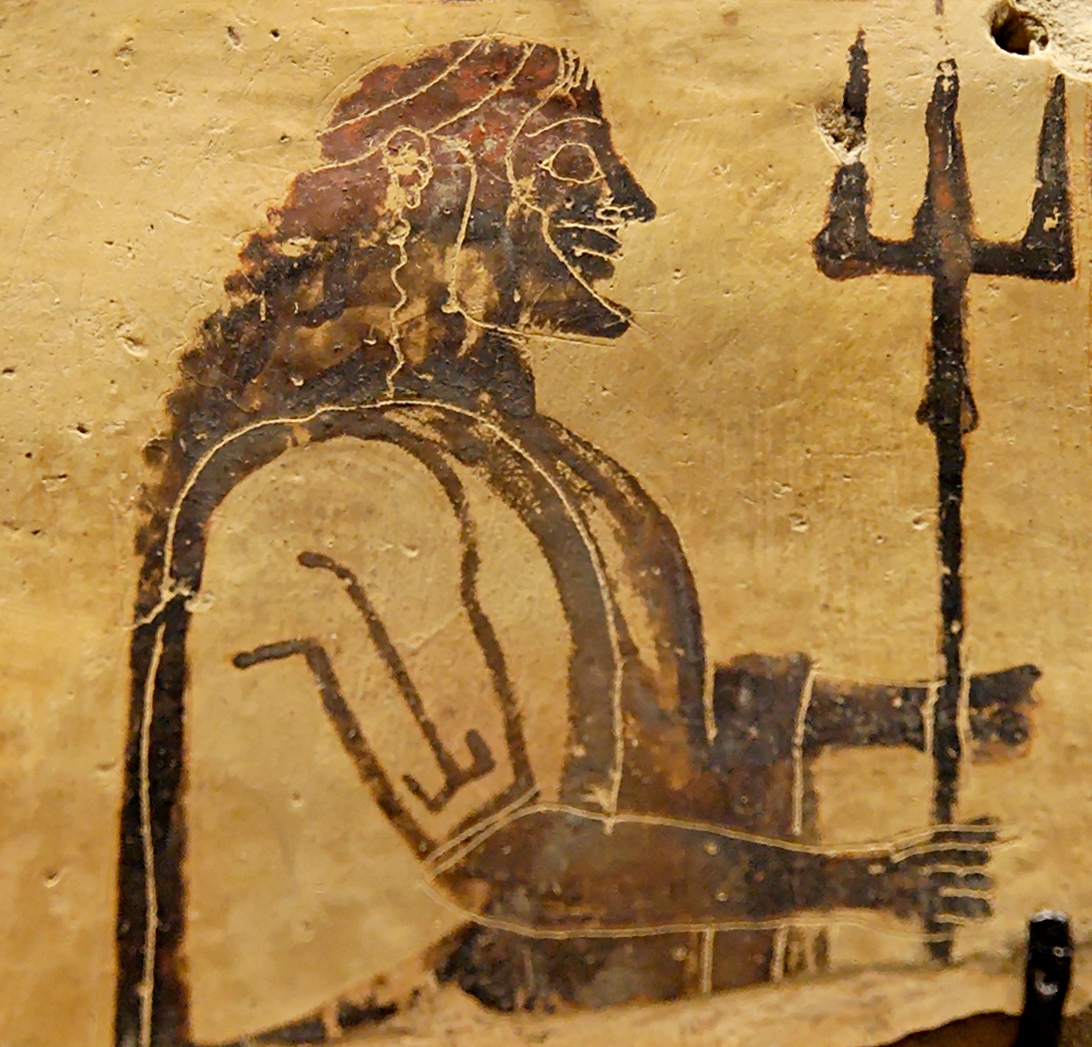
Poseidon was one of the twelve Olympian deities of the pantheon in Greek mythology. His main domain was the ocean, and he is called the "God of the Sea". Additionally, he is referred to as "Earth-Shaker," due to his role in causing earthquakes, and has been called the "tamer of horses." He is usually depicted as an older male with curly hair and beard.

The name of the sea-god Nethuns in Etruscan was adopted in Latin for Neptune in Roman mythology; both were sea gods analogous to Poseidon. Poseidon was venerated at Pylos and Thebes in pre-Olympian Bronze Age Greece as a chief deity, but he was integrated into the Olympian gods as the brother of Zeus and Hades. According to some folklore, he was saved by his mother Rhea, who concealed him among a flock of lambs and pretended to have given birth to a colt, which was devoured by Cronos.
There is a Homeric hymn to Poseidon, who was the protector of many Hellenic cities, although he lost the contest for Athens to Athena. According to the references from Plato in his dialogues Timaeus and Critias, the island of Atlantis was the chosen domain of Poseidon.


Moving On (Back to Earth)

I now plan to start an in-depth analysis of another one of my favorite college text-books, Persuasion in the Media Age.


Analysis of Persuasion in the Media Age


The Beginning


We are constantly bombarded by persuasive messages. Everyone from advertisers and politicians to our friends and colleagues seek to gain our support for their ideas, products or services. In today's world, persuaders use increasingly sophisticated ways of exerting influence over the attitudes, beliefs and behaviors of their audiences. It is essential that we develop an ability to critically analyze the persuasive messages we encounter. Consider two brief examples:

A television commercial for a new car tells us much more than how many miles to the gallon the car gets or which safety features it includes. Automobile advertising tells us what kind of cars we should drive, the cultural importance of driving particular cars and why it is important to have the freedom of mobility that driving affords. We often do not even realize how the implicit messages of advertisers affect our attitudes and ultimately our buying behavior.


Politicians - in combination with news media sources - use public opinion polling to shape the public's agenda telling us which issues are important and which are not. While this agenda may be reflective of some peoples' priorities, it is just as likely to exclude the priorities of many others. In fact, politicians purposely create agendas that ignore many members of the public instead targeting smaller influential groups that can help them with re-election.

As persuaders begin to target through direct-broadcast satellites, direct mail and narrowcasting television programming, the challenge of making informed decisions is even greater.


Poseidon, Paella Museum

Poseidon in Kadriorg PalaceTallinn

Persuasion in the Media Age explores the nature of persuasion today and offers strategies for critically evaluating persuasive communication. This analysis provides a contemporary response to an age old problem: understanding and adapting to the technological advances in our society. Today's world demands a new perspective of persuasion: one that is grounded in the assumption that human consciousness has been forever altered by communication technology. In order to respond to this fast-paced change, we must move beyond traditional theories to better understand how to respond to and evaluate persuasive communication in this era of technological advances.


Check this out to learn more about the mighty Greek god, Poseidon.

Tuesday, July 5, 2016

Look To The Future


Learning Organizations

Learning organizations rely on critical thinking and rigorously analyzed hard data to provide a long-term sustainable competitive edge relative to others in their industry. Unfortunately knowledge-creating organizations are still rare. Too many U.S. businesses instead fall prey to every new management fad promising a painless solution, especially when it is presented in a neat and bright package. This tendency has created a cottage industry of pop management books, which often substitute for serious thinking about the best way to manage in specific companies.


To avoid the quick-fix mentality, managers need to keep current with the literature in the field of management and to pay particular attention to journal articles that translate research findings into practical guidelines. Second, managers need to be skeptical when simple solutions are offered, and to analyze such solutions thoroughly. Managers need to ensure that the concepts they apply are based on science, and managers should experiment with new solutions themselves whenever possible - in other words, strive to make their organizations learning organizations.


The purpose of the upcoming series of articles on this blog is to help promote the kind of philosophy embodied by knowledge-creating organizations. Whereas these past articles on organizational behavior have focused on learning what is already known about management, I now plan to start writing more about the thinking process so that you yourself can learn new and innovative approaches to management. Being the first to discover and implement innovative management techniques will help give you a sustainable competitive advantage relative to those relying on ineffective and widely copied business fads.


Coming up in this next series of articles, I will begin by examining the nature of the scientific process in order to show you, the reader,  how to successfully conduct your own experiments. I will then go on to discuss how to draw valid causal inferences so that you can maximize your ability to learn from your own experiences as well as to critically evaluate claims made by others. I will then go on to discuss how to generalize research results to determine whether the results found in one sample and setting are likely to be repeatable in a different sample and setting. Finally, I will describe some of the scientific sources you can turn to in seeking answers to your managerial questions.

I must go now. Have a pleasant evening and a proactive tomorrow.

Friday, July 1, 2016

How To Train People To Be Sensitive

Sensitivity Training

Sensitivity training focuses on developing greater sensitivity to oneself, others and to one's relations with others. Designed to promote emotional growth and development, sensitivity training typically takes place in a closed session away from work. It may involve a collection of people who do not know each other, a group of people who are well acquainted or a combination of the two. A sensitivity training session may last for as little as half a day or go on for several days. It is begun by a change agent, who announces that the change agent's role is to serve solely as a non-directive resource. The change agent then lapses into silence leaving the participants with neither a leader nor an agenda to guide interpersonal activities. The purpose of putting people in such an ambiguous situation is to force them to structure relationships among themselves and in the process question long-held assumptions about themselves, about each other and about interpersonal relations.


Sensitivity training participants take part in an intense exchange of ideas, opinions, beliefs and personal philosophies as they struggle with the process of structuring interpersonal relations. Here is a description of 1 four-day session:
The first evening discussion began with a rather neutral opening process which very soon led to strongly emotional expressions of concern. By the second day, the participants had begun to express feelings toward each other quite directly and frankly, something they had rarely done in their daily work. As the discussion progressed, it became easier for them to accept criticism without becoming angry or wanting to strike back. From the second day onward the discussion was spontaneous and uninhabited. From early morning to long past midnight, the process of self-examination and confrontation continued. They raised questions they had never felt free to ask before. Politeness and superficiality yielded to openness and emotional expression.and then to more objective analysis of themselves and their relationships at work. They faced up to many conflicts and spoke of their differences. These were tense moments, as suspicion, distrust and personal antagonisms were aired, but more issues were worked out without acrimony.
By completing this process, people learn more about their own personal feelings, inclinations and prejudices and about what other people think of them.

A Word of Warning

Sensitivity training can initiate profound and intense psychological change. It is not uncommon for participants to engage in very critical assessments of themselves and others that can be both difficult and painful. Therefore the change agent overseeing sensitivity training must be a trained professional who can help participants deal with criticism in  a constructive manner. In the absence of expert help, participants could be at risk of serious psychological trauma. 

 The End

Rosary from Lourdes - 02/12/2025