Mission Statement

The Rant's mission is to offer information that is useful in business administration, economics, finance, accounting, and everyday life. The mission of the People of God is to be salt of the earth and light of the world. This people is "a most sure seed of unity, hope, and salvation for the whole human race." Its destiny "is the Kingdom of God which has been begun by God himself on earth and which must be further extended until it has been brought to perfection by him at the end of time."

Tuesday, May 5, 2020

Business Law (part 61)


I have been committed to carrying out my duties... in accordance with both the letter and spirit of all applicable rules of ethics and canons of conduct.

Real Estate Mortgages (part B)
 by
 Charles Lamson

 Rights of the Mortgagor

 The mortgagor has several rights, including:
  1. Possession of the property
  2. Rents and profits
  3. Cancellation of lien
  4. Redemption
  5. Sale of the property

Lady Justice Digital Art by Erzebet S

Possession of the Property

As the owner of the property, the mortgagor usually has the right to retain possession of the mortgaged property. Upon default the mortgagee usually may take possession to collect rents and profits and apply them to the mortgage debt in compliance with a duty as a fiduciary to the mortgagor. In some states possession cannot be taken, but the appointment of a receiver to collect rent and profits may be obtained.

Rents and Profits

The mortgagor, as the owner of the property, has the right to rent and profits from the property. In the absence of an express agreement to the contrary, the mortgagor has the right to all rents and profits obtained from the mortgaged property. The mortgagor may retain the profits. This rule or any other rule may, of course, be superseded by a contract providing otherwise.

Cancellation of Lien

The mortgagor has the right to have the lien cancelled on final payment. As soon as the mortgagee receives the mortgage, it becomes a lien upon the mortgaged real estate. The clerk in the recorder's office cancels a mortgage lien by entering a notation, usually on the margin, certifying that the debt has been paid and that the lien is canceled. The mortgagee, not the mortgagor, must have this done. If the mortgagee does not, the mortgagor may institute court action to have this cloud removed from the title so that there may be a clear title.

Redemption

The mortgagor has the right to free the mortgaged property from the lien of the mortgage after default, known as the right of redemption. Statutes in most states prescribe a specific time after the foreclosure and sale when this right may be exercised. In order to redeem the property, the mortgagor must pay the amount of the mortgage, the costs of the sale, and any amount paid to protect the purchasers interest in the property, such as taxes or insurance.

Lady Justice Art Print by canotstop | Society6

 Usually only a person whose interests will be affected by foreclosure may exercise the right of redemption. This includes the executor or administrator and heirs of the mortgagor, and frequently a second mortgage or junior lien holder.

Sale of the Property

The mortgagor has a right to sell the property on which a mortgage exists. The purchaser may agree to "assume all the mortgage," which means to be primarily liable for its payment. "Assuming" the mortgage differs from buying the property "subject to the mortgage." In the first case the buyer agrees to be liable for the mortgage obligation as fully as the original mortgagor. If the buyer takes the property "subject to the mortgage" and default occurs, the property may be lost, but no more.

A sale of the mortgaged property does not automatically release the original mortgagor whether the purchaser assumed the mortgage or bought it subject to the mortgage. The mortgagor remains fully liable in both cases.

To excuse the mortgagor from liability under a mortgage, a novation must take place. This can occur if the parties involved sign a written agreement releasing the mortgagor. Courts have also found novations if the mortgagee extends the time of payment for the purchaser of the property without the mortgagor's consent. Accepting an interest payment after the principle of the mortgage has become due constitutes an extension of the mortgage. If the mortgagee does this without the mortgagor's consent, a novation results and releases the mortgagor from all liability under the mortgage. However, the action of the mortgagee must amount to an extension of time of payment. 

Foreclosure

If the mortgagor fails to pay the debt secured by the mortgage when it becomes due, or fails to perform any of the other terms set forth in the mortgage, the mortgagee has the right to foreclose for the purpose of collecting the debt. Foreclosure usually consists of a sale of the mortgaged property. Generally an officer of the court makes the sale under an order of a court. The mortgagor must be properly notified of the foreclosure proceedings. 

Image result for chibi lady justice | Lady justice, Chibi, Anime

Foreclosure literally means "a legal proceeding to shut out all other claims." A first mortgage may not necessarily constitute a first claim on the proceeds of the sale. The cost of foreclosure and taxes always takes precedence over the first mortgage. People who furnish materials for the construction of a house and workers who work on it have a claim under what is known as a mechanics' lien. A mechanics' lien takes precedence over on recorded mortgages. The law varies somewhat among the states, but normally a mortgage recorded before a mechanics' lien attaches has priority. The foreclosure proceedings establish the existence of all prior claims and the order of their priority. Foreclosure proceedings are fixed by the statute and therefore vary in different states.

If the proceeds of the sale of mortgage property exceed the amount of the debt and the expenses of foreclosure the surplus must be used to pay off any other liens such as second mortgages. Any money remaining belongs to the mortgagor.

If a deficiency results, however, the mortgagee may secure a deficiency judgment for this amount. In that case the unpaid balance of the debt will stand as a claim against the mortgage here until payment of the debt.

When the mortgagor has given a mortgage for the purpose of purchasing the property, some states limit the amount of a deficiency judgment. The deficiency cannot be greater than the amount by which the debt exceeds either the fair market value or the selling price, whichever amount is smaller. This gives protection to the mortgagor from the mortgagee buying the property at foreclosure for a very low price. For example, suppose A mortgages property to B for $50,000, and the value of the property declines to $40,000. A defaults and B forecloses. B buys the property at foreclosure for $30,000. 
B may obtain a deficiency Judgment of $10,000 because it is the lesser of the two amounts.

Colored Justice Tattoo Design

Assignment of the Mortgage

The rights of the mortgagee under the mortgage agreement may be assigned. The assignee, the purchaser, obtains no greater rights than the assignor had. To be protected, the assignee should require the assignor to produce an estoppel certificate signed by the mortgagor. This certificate should acknowledge that the mortgagor has no claims of any kind in connection with the mortgage. This would bar the mortgagor from subsequently claiming the right of offset.

The assignee of a mortgage should have this assignment recorded. In the event that the mortgagee assigns the mortgage to more than one party, the one who records an assignment first has preference. This can be important when the proceeds are not adequate to pay both assignees.

Deed of Trust

In a number of states, parties commonly use a deed of trust instead of a mortgage for securing a debt with real estate. A mortgage involves two parties, a debtor and  a creditor. A deed of trust involves three parties. It conveys title to the property to a disinterested party, called a trustee. The trustee holds the property in trust for the benefit of the creditor. Most courts treat a deed of trust like a mortgage. If a default in payment occurs, the trustee forecloses on the property and applies the proceeds to the payment of the debt. The right to redeem under a deed of trust, when it exists, is similar to the right of redemption under a mortgage.

The advantage to the creditor in using a deed of trust instead of a mortgage is in the power held by the trustee. In the event a mortgagor defaults in the payments, the mortgagee who holds an ordinary mortgage can foreclose. In most states, however, the mortgagee must go into court and have a judicial foreclosure in order to have the mortgaged property sold to satisfy the debt. A trustee of a deed of trust may sell the mortgaged property at public auction if the debtor defaults. No time-consuming court foreclosure proceedings are necessary. Hence, the property can be sold more quickly at a trustee's sale.

Mortgage Insurance

Private companies and several agencies of the federal government insure or guarantee mortgagors against their fault by the mortgagor. The insurance lasts for the term of the mortgage. The government agrees to pay in case of default by the mortgagor in order to make it easier for some people to obtain a mortgage. The most frequently used government programs are those administered by the Federal Housing Administration (FHA) and the Veterans Administration (VA).

Lady Justice by Mg3-Kiryu on DeviantArt

FHA-insured mortgages require a smaller down payment than conventional mortgages. Anyone who meets the financial qualifications may obtain an FHA loan. Because FHA mortgages are insured, the interest rate is slightly less than for a conventional mortgage. The FHA sets a maximum amount that may be mortgaged. The FHA bases this amount on the average sale price in the area for a home. The mortgagor pays premiums for this mortgage insurance.

The VA guarantees mortgages for people who have served on active duty in the armed forces for a minimum of time. The mortgage must be on owner-occupied property. The VA charges the mortgagor a percentage of the loan amount for its guarantee. It sets the interest rate charged. As a benefit to veterans, it sets this rate less than the market rate for conventional loans. A VA mortgage may be for up to 100 percent of the value of the real estate. This means no down payment is required. The maximum loan amount is $144,000. 

INTERNET RESOURCES FOR BUSINESS LAW

Name 
Web Addresses
Links
U.S Department of Housing and Urban Development (HUD)
HUD provides information on real property and planning issues for both consumers and businesses. HUD also provides information on the Fair Housing Act and the Civil Rights Act.
HUD USER
HUD USER, PD&R's information source for housing and community development researchers and policymakers, provides federal government reports and information on housing policy and programs, building technology, economic development, urban planning, and other housing related topics.
Legal Information Institute (LII)---Land-Use Law Materials
LII, maintained by Cornell Law School, provides an overview a land-use law, links to statutes, federal and state judicial court decisions, and other materials.
Themis | Greek goddess | Britannica
Themis - Justice | Arte grega antiga, Arte antiga, Arte grega
Themis - Atlas

Color Ink Lady Justice Tattoo Design For Girls

*SOURCE: LAW FOR BUSINESS, 15TH ED., 2005, JANET E. ASHCROFT, J.D., PGS. 520-524, 527*

end

Sunday, May 3, 2020

Business Law (part 60)


It is legal because I wish it.


Real Estate Mortgages (part A)
by
 Charles Lamson

 A mortgage is an interest in real estate given to secure the secure the payment of a debt. The mortgage does not constitute the debt itself but the security for the debt. If the debt is not paid the property may be sold to pay the debt. Land or any interest in land may be mortgaged. Land maybe mortgage separately from the improvements, or the improvements may be mortgaged apart from the land. A person who gives a mortgage as a security for a debt is a mortgagor. A person who holds a mortgage as property for a debt is a mortgagee.

Justice Digital Art by Emma Alvarez

The mortgagor normally retains possession of the property. In order for the mortgagee to obtain the benefit of the security, the mortgagee must take possession of the premises upon default or sell the mortgaged property at a foreclosure sale. In some states, the mortgagee may not take possession of the property upon default but may obtain the appointment of a receiver to collect the rents and income. If the sale of the property brings more than the debt and the costs, the mortgagor must be paid the balance. 

The Mortgage Contract

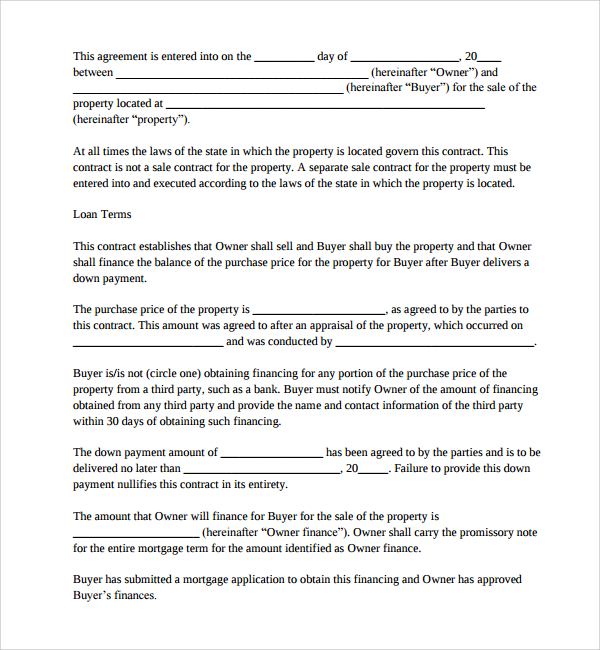
A mortgage must be in writing. The contract, as a rule, must have the same form as a deed, which means it must be acknowledged. The mortgage, like all other contracts sets forth the right and the duties of the contracting parties (see Illustration 1). As a type of contract, mortgages are interpreted according to contract law rules.

ILLUSTRATION 1 Mortgage Contract
FREE 12+ Sample Mortgage Agreement Templates in PDF | MS Word ...

A mortgagor normally gives a mortgage to raise money for the purchase price of real estate, but it may be given for other reasons. One may borrow money for any reason and secure the loan by a mortgage. One may assume a contingent liability for another, such as becoming a surety, and receive a mortgage as security.

The effect of a mortgage is to be a lien against the mortgaged property. A lien is an encumbrance or claim against property. The lean of the mortgage attaches to the property described in the mortgage. A mortgage generally also provides that the lien attaches to additions thereafter made to the described property; for example, the lien of the mortgage attaches to personal property, which thereafter becomes a fixture. A clause purporting to make the security clause of a mortgage becomes a fixture. A clause purporting to make the security clause of a mortgage cover future debts will be valid if the parties intended it to cover future debts.

Exhibit 17: Lady Justice | Lady justice, Justice tattoo, Law tattoo

Recording

Depending upon the law of the state in which the land lies, the mortgage gives the mortgagee either a lien on the land or title to the land. The mortgagor's payment of the debt divests or destroys this title or lien. Recording the mortgage protects the mortgagee against subsequent creditors, since the public record normally constitutes notice to the whole world as to the mortgagee's rights. There may be both a first mortgage and subsequent, or junior, mortgages. The mortgage recorded first normally has preference. This is not true of when actual notice of a prior mortgage exists. However, a purchase money mortgage has preference over other claims arising through the mortgagor. The mortgage is also recorded to notify its subsequent purchasers that as much of the purchase price as is necessary to pay off the mortgage must be paid to for the mortgagee. Recording must be proper, otherwise the purpose of the mortgagee providing notice to others cannot be accomplished. 

Duties of the Mortgagor

The mortgagor assumes three definite duties and liabilities when placing a mortgage upon real estate. These pertain to:
  1. Interest and principal
  2. Taxes, assessments, and insurance premiums
  3. Security of the mortgagee

Interest and Principal

The mortgagor must make all payments of interest and principal as they become due. Most mortgages call for periodic payments, such as monthly, semiannually, or annually. These payments are used to pay all accrued interest to the date of payment, and the mortgagee applies the balance on the principal. Other mortgages call for periodic payment of interest and for the payment of the entire principal at one time. In either case, a failure to pay either the periodic payments of interest and principal or of interest only constitutes a default. A default gives the mortgagee the right to foreclose. Most mortgages contain a provision that if the mortgagor does not make an interest or principal payment when due or within a specified time after due, the mortgagee may declare the entire principal immediately due. This is known as an acceleration clause.

Card of the Day – Justice – Monday, June 12, 2017 – Tarot by Cecelia

If the mortgagor wishes to pay off the mortgage debt before the due date so as to save interest, that right must be reserved at the time the mortgage is given. 

Taxes, Assessments, and Insurance Premiums

The mortgagor, who is the owner of the land regardless of the form of the mortgage, must continue to make such payments as would be expected of an owner of land. The mortgagor must pay taxes and assessments. If the mortgagor has not paid the taxes and assessments, the mortgagee must pay them and compel a reimbursement from the mortgagor. If the mortgage contract requires the mortgagor to pay these charges, a failure to pay them becomes a default.

The law does not require the mortgagor to keep the property insured nor to insure it for the benefit of the mortgagee. This duty cannot be imposed on the mortgagor by the mortgage contract. Both the mortgagor and mortgagee have an insurable interest in the property to the extent of each one's interest or maximum loss.

Security of the Mortgagee

The mortgagor must do not act that will materially impair the security of the mortgagee. Cutting timber, tearing down buildings, and all acts that waste the assets impair the security and give the mortgagee the right to seek legal protection. Some state statutes provide that any one of these acts constitutes a default. This gives the mortgagee the right to foreclose. Other statues provide only that the mortgagee may obtain an injunction in a court of equity enjoining any further impairment. Some states provide that for the appointment of a receiver to prevent waste. Many state laws also make it a criminal offence to willfully impair the security of mortgaged property. 

Card of the Day for April 7, 2020 in 2020 | Justice tarot, Tarot ...

*SOURCE: BUSINESS FOR LAW, 15TH ED., 2005, JANET E. ASHCROFT. J.D., PGS. 516-520*

end

Wednesday, April 15, 2020

Business Law (part 59)


If you must break the law, do it to seize power: in all other cases observe it.

Julius Caesar


Transfer of Real Property
 by
 Charles Lamson

A sale constitutes the most common reason for transferring title to real estate. In the ordinary case, the parties sign a contract of sale, but the title is not transferred until the seller delivers a deed to the buyer. A deed is a writing, signed by the owner, conveying title to real property. One may, by means of a lease, transfer a leasehold title giving the rights to the use and possession of land for a limited period. The provisions of the deed or the lease determine the extent of the interest transferred.

The Goddess that Represents You According to Your Zodiac Sign

Even when the owner makes a gift of real property, the transfer must be evidenced by a deed. As soon as the owner executes and delivers a deed, title vests fully in the donee. Acceptance by the donee is presumed.

Deeds

The law sets forth the form that the deed must have, and this form must be observed. The parties to the deed include the grantor, or original owner, and the grantee, or recipient. The two principal types of deeds are:

  1. Quitclaim deeds
  2. Warranty deeds
Quitclaim Deeds

A quitclaim deed is just what the name implies. The grantor gives up whatever interest he or she may have in the real property. However, the grantor makes no warranty that he or she has any claim to the property.

In the absence of a statute or an agreement between the parties requiring a warranty deed, a quitclaim deed may be used in making all conveyances of real property. A quitclaim deed transfers the grantor's full and complete interest as effectively as a warranty deed. When buying real property, however, one does not always want to buy merely the interest that the grantor has. A buyer wants to buy a perfect and complete interest so that the title cannot be questioned by anyone. A quitclaim deed conveys only the interest of the grantor and no more. It contains no warranties that the grantor has good title. In most real estate transactions, therefore, a quitclaim deed cannot be used because the contract will specify that a warranty deed must be delivered.

Warranty Deed

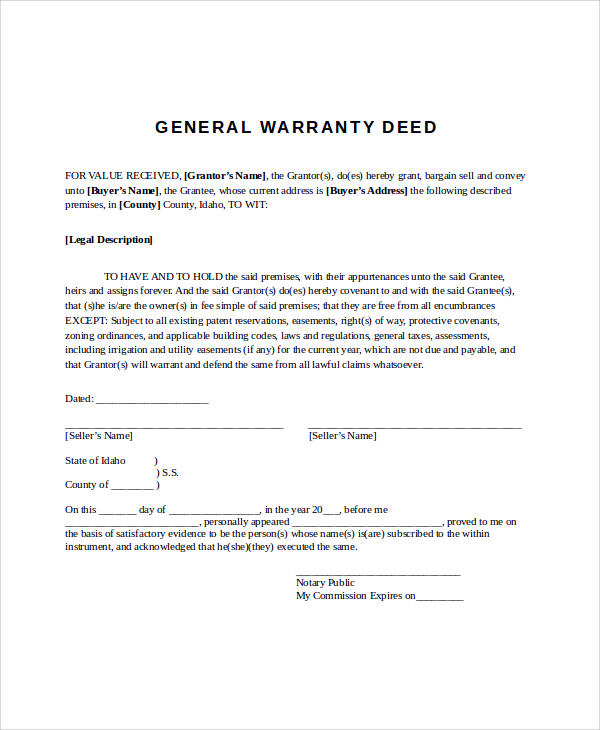
A warranty deed that not only conveys the grantor's interest in the real property but, in addition, makes certain warranties or guarantees. The exact nature of warranty or guarantee depends upon whether the deed is a general warranty or a special warranty deed. A general warranty deed (see Illustration 1) not only warrants that the grantor has good title to the real property but further warrants that the grantee "shall have quiet and peaceable possession, free from all encumbrances, and that the grantor will defend the grantee against all claims and demands from whomsoever made." This warranty, then, warrants that all prior grantors had good title and that no defects exist in any prior grantor's title. The grantee does not have to assume any risks as the new owner of the property.

ILLUSTRATION 1 General Warranty Deed
FREE 9+ General Warranty Deed Samples in MS Word | PDF

Themis by Liza Otchenashenko on Dribbble

A special warranty deed warrants that the grantor has the right to sell the real property. The grantor makes no warranties of the genuineness of any prior grantor's title. Trustees and sheriffs who sell land at a foreclosure sale use this type of deed. Executives and administrators also use such a deed. These officials should not warrant anything other than that they have the legal right to sell whatever interest the owner has.

When a builder sells the new house, most courts now impose an implied warranty of fitness not found in the deed. The warranty amounts to a promise that the builder designed and constructed the house in a workmanlike manner, suitable for habitation by the buyer.

Provisions in a Deed

Unless statutes provide otherwise, a deed usually has the following provisions:

  1. Parties
  2. Consideration
  3. Covenants
  4. Description
  5. Signature
  6. Acknowledgement 
Parties

The grantor and the grantee must be identified, usually by name, in the deed and the grantee must be a living or legal person. If the grantor is married, the grantor's name and that of a spouse should be written in the deed. If the grantor is unmarried, the word single or the phrase "a single person" should be used to indicate that status.

Consideration

The amount paid to the grantor for the property is the consideration. The payment may be in money or in money's worth. A deed usually includes a statement of the consideration, although the amount specified does not need to be the actual price paid. Some localities have a practice of indicating normal amount, such as $1, although a much larger sum was actually paid. The parties state a nominal amount as the consideration to keep the sale price from being a matter of public record.

Covenants

A covenant is a promise contained in a deed. There may be as many covenants as the grantor and the grantee wish to include. Affirmative covenants obligate the grantee to do something, such as agreeing to maintain a driveway used in common with adjoining property. In negative covenants the grantee agrees to refrain from doing something. Such covenants frequently appear in deeds for urban residential developments. The more common ones prohibit the grantee from using the property for business purposes and set forth the types of homes that can or cannot be built on the property. Most covenants run with the land, which means they bind all future owners. 

Description

The property to be conveyed must be correctly described. Unless the law provides otherwise, any description that will clearly identify the property suffices. Ordinarily, however, the description used in the deed by which the present owner acquired the title should be used if correct. The description May be by lots and blocks if the property is in a city or it may be by metes and bounds or section, range, and township if the property is in a rural area. If the description is indefinite, the grantor retains title. 

Signature

The grantor should sign the deed in the place provided for the signature. A married grantor must have the spouse also sign for the purpose of giving up a statutory right of the spouse. In some states a witness or witnesses must attest the signatures. If the grantor cannot sign the deed, an agent, the grantor with assistance, or the grantor making a mark, may execute it as:


September 28, 2019 -New Moon in Libra

Acknowledgement

The statutes normally require that the deed be formally acknowledged before a notary republic or other officer authorized to take acknowledgements. The acknowledgment allows the deed to be recorded. After a deed has been recorded, it may be used as evidence in a court without further proof of its authenticity. Recording does not make a deed valid, but it helps give security of the title to the grantee.

The acknowledgement is a declaration made by the properly authorized officer, in the form provided for that purpose, that the grantor has acknowledged signing the instrument as a free act and deed. In some states the grantor must also understand the nature and effect of the deed or be personally known to the acknowledging officer. The officer attests to these facts and affixes an official seal. The certificate provides evidence of these actions.

Delivery

A deed has no effect on the transfer of an interest in real property until it has been delivered. Delivery consists of the grantor intending to give up title, possession, and control over the property. So long as the grantor maintains control over the deed and reserves the right to demand its return before delivery of the deed to the grantee, there has been no legal delivery. If the grantor executes a deed and leaves it with an attorney to deliver the grantee, there has been no delivery until the attorney delivers the deed the to the grantee. Since the attorney is the agent of the grantor, the grantor has the right to demand that the agent return the deed. Is The grantor, however, delivers the deed to the grantee's attorney or agent, then there has been effective delivery because releasing control constitutes evidence of intent that title passed. Once the grantor makes delivery, title passes. 

Recording

Statutes in every state require grantees to file their deeds with a public official in the country in which the land lies. Any other instrument affecting title to real property in the country can also be filed. These public records of land transactions give notice of title transfers to all, particularly potential subsequent purchasers.

How the New Moon in Libra of September 2019 Will Influence You ...

A deed need not be recorded in order to complete one's title. Title passes upon delivery of the deed. Recording the deed protects the grantee against a second sale by the grantor and against any liens that may attach to the property while still recorded in the grantor's name. Recording also raises the presumption of delivery of the deed.

When the recording official receives a deed for recording, the law ordinarily requires that the deed be stamped with the exact date and time the grantee leaves the deed for recording.

Abstract of Title

Before one buys real estate, an abstract of title may be prepared. An abstract company normally does this, but an attorney may also do it. The abstract of title gives a complete history of the real estate. It also shows whether or not there are any unpaid taxes and assessments, outstanding mortgages, unpaid judgments, or other unsatisfied liens of any type against the property. Once an abstracting company makes the abstract, an attorney normally examines the abstract to see if it reveals any flaws in the title.

Title Insurance

Some defects in the title to real estate cannot be detected by an abstract. Some of the most common of these defects are forgery of signatures in prior conveyances; claims by adverse possession; incompetency to contract by any prior party; fraud; duress; undue influence; defective wills; loss of real property by accretion; and errors by title examiners, tax officials, surveyors, and many other public officials. Title insurance policy can be obtained that will cover these defects. The policy may expressly exclude any possible defects that the insurance company does not wish to be covered by the policy. The insured pays one premium for coverage as long as the property is owned. The policy does not benefit a subsequent purchaser or a mortgagee.

*SOURCE: LAW FOR BUSINESS, 15TH ED., 2005, JANET E. ASHCROFT, J.D., PGS. 507-513* 

end

Rosary from Lourdes - 02/12/2025