Mission Statement

The Rant's mission is to offer information that is useful in business administration, economics, finance, accounting, and everyday life. The mission of the People of God is to be salt of the earth and light of the world. This people is "a most sure seed of unity, hope, and salvation for the whole human race." Its destiny "is the Kingdom of God which has been begun by God himself on earth and which must be further extended until it has been brought to perfection by him at the end of time."

Wednesday, October 16, 2019

Managing for Competitive Advantage (part 1)

The Evolution of Management
 by
 Charles Lamson

 For thousands of years, managers have wrestled with the same issues and problems confronting executives today. Around 1100 B.C., the Chinese practiced the four management functions---planning (specifying the goals to be achieved and deciding in advance the appropriate actions needed to achieve those goals), organizing (assembling and coordinating the human, financial, physical, informational, and other resources needed to achieve goals), leading (stimulating people to be high performers), and controlling (monitoring progress and implementing necessary changes). Between 350 and 400 BC, the Greeks recognized management as a separate art and advocated a scientific approach to work. The Romans decentralized the management of their vast empire before the birth of Christ. During medieval times, the Venetians standardized production through the use of an assembly line, building warehouses and using an inventory system to monitor the contents.

Image result for the nile river

But throughout history most managers operated strictly on a trial-and-error basis. The challenges of the industrial revolution changed that. Management emerged as a formal discipline at the turn of the century. The first university programs to offer management and business education, the Wharton School at the University of Pennsylvania and the Amos Tuck School at Dartmouth, were founded in the late 19th century. By 1914, 25 Business schools existed.

Thus, the management profession as we know it today is relatively new. This post explores the roots of modern management theory. Understanding the origins of management thought will help you grasp the underlying contexts of the all the ideas and concepts presented in the posts ahead.

Although this post is titled "The Evolution of Management," it might be more appropriately called "The Revolutions of Management," because it documents the wide swings in management approaches over the last 100 years. Out of the great variety of ideas about how to improve management, parts of each approach have survived and been incorporated into modern perspectives on management. Thus, the legacy of past efforts, triumph, and failures has become our guide to future management practice.

Early Management Concepts and Influences

Communication and transportation constraints hindered the growth of earlier businesses. Therefore, improvements in management techniques did not substantially improve performance. However, the industrial revolution changed that. As companies grew and became more complex, minor improvements in management tactics produced impressive increases in production quantity and quality.

The emergence of economies of scale---reductions in the average cost of a unit of production as the total volume produced increases---drove managers to strive for further growth. The opportunities for mass production created by the industrial revolution spawned intense and systematic thought about management problems and issues---particularly efficiency, production processes, and cost savings.

Image result for the nile river

This post depicts the evolution of management through the mid-to-late 19th, 20th, and early 21st centuries. This historical perspective is divided into two major sections: classical approaches and contemporary approaches. Many of these approaches developed simultaneously, and they often had a significant impact on one another. Some approaches were a direct reaction to the perceived deficiencies of previous approaches. Others developed as the needs and issues confronting managers changed over the years. All the approaches attempted to explain the real issues facing managers and provide them with tools to solve future problems.

Classical Approaches

The classical period extended from the mid-nineteenth century through the early 1950s. The major approaches that emerged during this. Were systematic management, scientific management, administrative management, human relations, and bureaucracy.

Systematic Management During the 19th century, growth in U.S. business centered on manufacturing. Early writers such as Adam Smith believed the management of these firms was chaotic, and their ideas helped to systematize it. Most organizational tasks are subdivided and performed by specialized labor. However, poor coordination among subordinates and different levels of management cause frequent problems and breakdowns of the manufacturing process.

The systematic management approach attempted to build specific procedures and processes into operations to ensure coordination of effort. Systematic management emphasized economical operations, adequate staffing, maintenance of inventories to meet consumer demands, and organizational control. These goals were activated through

  • Careful definition of duties and responsibilities.
  •  Standardized techniques for performing these duties.
  •  Specific means of gathering, handling, organizing, and analyzing information.
  •  Cost accounting, wage, and production control systems to facilitate internal coordination and communications.

Image result for the nile river

Systematic management emphasized internal operations because managers were concerned primarily with meeting the explosive growth in demand brought about by the industrial revolution. In addition, managers were free to focus on internal issues of efficiency, in part because the government did not constrain business practices significantly. Finally, labor was poorly organized. As a result, many managers were oriented more toward things than toward people.

Although systematic management did not address all the issues 19th century managers faced, it tried to raise managers' awareness about the most pressing concerns of their job.

Scientific Management Systematic management failed to lead to widespread production efficiency. The shortcoming became apparent to a young engineer named Frederick Taylor who was hired by Midvale Steel Company in 1878. Taylor discovered that production and pay were poor, inefficiency and waste were prevalent, and most companies had tremendous unused potential. He concluded that management decisions were unsystematic and that no research to determine the best means of production existed.

In response, Taylor introduced a second approach to management known as scientific management. This approach advocated the application of scientific methods to analyze work and to determine how to complete production tasks efficiently. For example, U.S. Steel's contract with the United Steelworkers of America specified that sand shovelers should move 12.5 shovelfuls per minute: shovelfuls should average 15 pounds of river sand composed of 5.5% moisture. 

Taylor identified four principles of scientific management:

  1. Management should develop a precise, scientific approach for each element of one's work to replace general guidelines.
  2.  Management should scientifically select, train, teach, and develop each worker so that the right person has the right job.
  3.  Management should cooperate with workers to ensure that jobs match plans and principles.
  4.  Management should ensure an appropriate division of work and responsibility between managers and workers.
To implement this approach Taylor use techniques such as time and motion studies. With this technique, a task was divided into its basic movements, and different motions were timed to determine the most efficient way to complete the task.

Image result for the nile river

After the one best way to perform the job was identified, Taylor stressed the importance of hiring and training the proper worker to do that job. Taylor advocated the standardization of tools, the use of instruction cards to help workers, and breaks to eliminate fatigue.

Another key element of Taylor's approach was the use of the differential piece-rate system. Taylor assumed workers were motivated by receiving money. Therefore, he implemented a pay system in which workers were paying additional wages when they exceeded a standard level of output for each job. Taylor concluded that both workers and management would benefit from such an approach.

Scientific management principles were widely embraced. Other properties, including other proponents, including Henry Gantt and Frank and Lillian Gilbreth, introduced many refinements and techniques for applying scientific management on the factory floor. One of the most famous examples of the application of scientific management is the factory Henry Ford built to produce the Model T.

At the turn of the century, automobiles were a luxury that only the wealthy could afford. They were assembled by craftspeople who put an entire car together at one spot on the factory floor. These workers were not specialized and Henry Ford believed they wasted time and energy bringing the needed parts to the car. Ford took a revolutionary approach to automobile manufacturing by using scientific management principles.

Administrative Management The administrative management approach emphasized the perspective of senior managers within the organization, and argued that management was a profession and could be taught.

An explicit and broad framework for administrative management emerged in 1916, when Henri Fayol, a French mining engineer and executive, published a book summarizing his management experiences. Fayol identified five functions and of management. The five functions, which are very similar to the four functions discussed in the opening paragraph of this post, include planning, organizing, commanding, coordinating, and controlling.

Image result for the nile river

A host of other executives contributed to the administrative management literature. These writers discussed a broad spectrum of management topics, including the social responsibilities of management, the philosophy of management, clarification of business terms and concepts, and organizational principles. Chester Barnard's and Mary Parker Follet's contributions have become classic works in this area.

Barnard, former president of New Jersey Bell Telephone Company, published his landmark book The Function of the Executive in 1938. He outlined the role of the senior executive: formulating the purpose of the organization, hiring key individuals, and maintaining organizational communications. Mary Parker Follet's 1942 book Dynamic Organization extended Barnard's work by emphasizing that continually changing situations that managers face. Two of her key contributions---the notion that managers desire flexibility and the difference is between motivating groups and individuals---laid the groundwork for the modern contingency approach discussed later in this post.

All the writings in the administrative management area emphasized management as a profession along with fields such as law and medicine. In addition, these authors offered many recommendations based on their personal experiences, which often included managing large corporations. Although these perspectives and recommendations were considered sound, critics noted that they might not work in all settings. Different types of personnel, industry conditions, and technologies may affect the appropriateness of these principles.

Human Relations A fourth approach to management, human relations, developed during the 1930s. This approach aimed at understanding how psychological and social processes interact with the work situation to influence performance. Human relations was the first major approach to emphasize informal work relationships and worker satisfaction.
Image result for the nile river

This approach owes much to other major schools of thought. For example, many of the ideas of the Gilbreths (scientific management) and Barnard and Fullet (administrative management) influenced the development of human relations from 1930 to 1955. In fact, human relations emerged from a research project that began as a scientific management study. 

Western Electric Company, a manufacturer of communications equipment, hired a team of Harvard researchers led by Elton mayo and Fritz Roethlisberger. They were to investigate the influence of physical working conditions on worker productivity and efficiency in one of the company's factories outside Chicago. This research project known as the Hawthorne Studies, provided some of the most interesting and controversial results in the history of management.

The Hawthorne Studies were a series of experiments conducted from 1924 and 1932. During the first stage of the project (The Illumination Experiments), various working conditions, particularly the lighting in the factory were altered to determine the effects of those changes on productivity. The researchers found no systematic relationship between the factory lighting and production levels. In some cases, productivity continued to increase even when the illumination was reduced to the level of moonlight. The researchers concluded that the workers performed and reacted differently because the researchers were observing them. This reaction is known as the Hawthorne Effect.

This conclusion led the researchers to believe productivity may be affected more by psychological and social factors than by physical or objective influences. With this thought in mind, they initiated the other four stages of the project. During these stages, the researchers performed various work group experiments and had extensive interviews with employees. Mayo and his team eventually concluded that productivity and employee behavior or influenced by the informal work group.

Image result for the nile river

Human relations proponents argued that managers should stress primarily employee welfare, motivation, and communication. They believed social needs had precedence over economic needs. Therefore, management must gain the cooperation of the group and promote job satisfaction and group norms consistent with the goals of the organization.

Another noted contributor to the field of human relations was Abraham Maslow. In 1943, Maslow suggested that humans have five levels of needs. The most basic needs are the physical needs for food, water, and shelter, the most advanced need is for self-actualization, or personal fulfillment. Maslow argued that people try to satisfy their lower-level needs and then progress upward to the highest level needs. Managers can facilitate this process and achieve organizational goals by removing obstacles and encouraging behaviors that satisfy people's needs and organizational goals simultaneously.

Although the human relations approach generated research into leadership, job attitudes, and group dynamics, it drew heavy criticism. Critics believed that one result of human relations---a belief that a happy worker was a productive worker---was too simplistic. While scientific management overemphasized the economic and formal aspects of the workplace, human relations ignored the more rational side of the worker and the important characteristics of the formal organization. However, human relations was a significant step in the development of management thought, because it prompted managers and researchers to consider the psychological and social factors that influence performance.

Bureaucracy Max Weber, a German sociologist, lawyer, and social historian, showed how management itself could be more efficient and consistent in his book The Theory of Social and Economic Organizations. The ideal model for management, according to Weber, is the bureaucracy approach.

Weber believed bureaucratic structures can eliminate the variability that results when managers in the same organization have different skills, experiences, and goals. Weber advocated that the jobs themselves be standardized so that personal changes would not disrupt the organization. He emphasized a structured, formal network of relationships among specialized positions in an organization. Rules and regulations standardized behavior, and authority resides in positions rather than in individuals. As a result, the organization need not rely on a particular individual, but will realize efficiency and success by following the rules in a routine and unbiased manner. 

Image result for the nile river

According to Weber, bureaucracies are especially important because they allow large organizations to perform the many routine activities necessary for their survival. Also, bureaucratic positions foster specialized skills, eliminating many subjective judgments by managers. In addition, if the rules and controls are established properly, bureaucracies should be unbiased in their treatment of people, both customers and employees.

Many organizations today are bureaucratic. Bureaucracy can be efficient and productive. However, bureaucracy is not the appropriate model for every organization. Organizations or departments that need rapid decision-making and flexibility may suffer under a bureaucratic approach. Some people may not perform their best with excessive bureaucratic rules and procedures.

Other shortcomings stem from a faulty execution of bureaucratic principles rather than from the approach itself. Too much authority may be vested in too few people, the procedure may become the ends rather than the means of managers or managers may ignore appropriate rules and regulations. Finally, one advantage of a bureaucracy---its permanence---can also be a problem. Once a bureaucracy is established, dismantling it is very difficult.

Contemporary Approaches

The Contemporary approaches to management include quantitative management, organizational behavior, systems theory, and the contingency perspective. Contemporary approaches have developed at various times since World War II, and they continue to represent the cornerstones of modern management thought.

Image result for the nile river

Quantitative Management Although Taylor introduced the use of science as a management tool early in the twentieth century, most organizations did not adopt the use of quantitative techniques for management problems until the 1940s and 1950s. During World War II, military planners began to apply mathematical techniques to defense and logistic problems. After the war, private corporations began assembling teams of quantitative experts to tackle many of the complex issues confronting large organizations. This approach, referred to as quantitative management, emphasizes the application of quantitative analysis to management decisions and problems.

Quantitative management helps a manager make a decision by developing formal mathematical models of the problem. Computers have facilitated the development of specific quantitative methods. These include such techniques as statistical decision theory, linear programming, queuing theory, simulation, forecasting, inventory modeling, network modeling, and break-even analysis. Organizations apply these techniques in many areas, including production, quality control, marketing, human resources, finance, distribution, planning, and research and development.

Despite the promise quantitative management holds, managers do not rely on these methods as the primary approach to decision-making. Typically, they use these techniques as a supplement or tool in the decision process. Many managers will use results that are consistent with their experience, intuition, and judgment, but they will reject results that contradict their beliefs. Also, managers may use the process to compare alternatives and eliminate weaker options.

Several explanations account for the limited use of quantitative management. Many managers have not been trained in using these techniques. Also, many aspects of a management decision cannot be expressed through mathematical symbols and formulas. Finally, many of the decisions managers face are non-routine and unpredictable.

Organizational Behavior During the 1950's, a transition took place in the human relations approach. Scholars began to recognize that worker productivity and organizational success are based on more than the satisfaction of economic or social needs. The revised perspective known as organizational behavior, studies and identifies management activities that promote employee effectiveness through an understanding of the complex nature of individual, group, and organizational processes. Organizational behavior draws from a variety of disciplines including psychology and sociology to explain the behavior of people on the job.

During the 1960s, organizational behaviorists heavily influenced the field of management. Douglas McGregor's Theory X and Theory Y marked the transition from human relations. According to McGregor, Theory X managers assume workers are lazy and irresponsible and require constant supervision and external motivation to achieve organizational goals. Theory Y managers assume employees want to work and can direct and control themselves. McGregor advocated a Theory Y perspective, suggesting that managers who encourage participation and allow opportunities for individual challenge and initiative would achieve superior performance.

Other major organizational behaviorists include Chris Argyris, who recommended greater autonomy and better jobs for workers, and Rinsis Likert, who stressed the value of participative management. Through the years, organizational behavior has consistently emphasized development of the organization's human resources to achieve individual and organizational goals. Like other approaches, it has been criticized for its limited perspective, although more recent contributions have a broader and more situational viewpoint. In the past few years, many of the primary issues addressed by organizational behavior have experienced a rebirth with a greater interest in leadership, employee involvement, and self-management.

Image result for the nile river

Systems Theory The classical approaches as a whole were criticized because they (1) ignored the relationship between the organization and its external environment, and (2) usually stressed what aspect of the organization or its employees at the expense of other considerations. In response to these criticisms, management scholars during the 1950's stepped back from the details of the organization to attempt to understand it as a whole system. These efforts were based on a general scientific approach called systems theory. An organization is a managed system that transforms inputs (raw materials, people, and other resources) into outputs (the goods and services that comprise its products).

Contingency Perspective Building on systems theory ideas, the contingency perspective refutes universal principles of management by stating that a variety of factors, both internal and external to the firm, may affect the organization's performance. Thus, there is no one best way to manage and organize, because circumstances vary. For example, a universal strategy of offering low-cost products would not succeed in a market that is not cost-conscious.

Situational characteristics are called contingencies. Understanding contingencies helps a manager know which set of circumstances dictate which management actions. You will learn the recommendations for the major contingencies throughout this analysis. The contingencies include:

  1. Circumstances in the organization's external environment.
  2.  The internal strengths and weaknesses of the organization.
  3.  The values, goals, skills, and attitudes of managers and workers in the organization.
  4.  The types of tasks, resources, and technologies the organization uses. 
With an eye to these contingencies, a manager may categorize the situation and then choose the proper competitive strategy, organization structure, or management process for the circumstances.

Researchers continue to identify key contingency variables and their effect on management issues. As you read the topics covered in each part of this analysis, you will notice the similarities and differences among management situations and the appropriate responses. This perspective should represent a cornerstone of your approach to management. Many of the things you will learn about throughout this analysis apply a contingency perspective.

Contemporary Approaches

All of these historical perspectives have left legacies that affect contemporary management thought and practice. There undercurrents continue to flow, even as the context and the specifics change.

Image result for the nile river

But new approaches to management continue to appear and contribute to an ever-changing management profession. The remaining posts report on these dynamic, contemporary perspectives. For example, the 1980s brought a new gospel called quality management, new perspectives on competition and on business strategy, a focus on excellence, and a renewed interest in people, including both employees and customers. The 1990s brought theories and practices such as learning organization, lean manufacturing, knowledge management, and the characteristics of corporate cultures that helped to build great and enduring companies. The rest of this analysis, and perhaps the rest of your career, will be spent enacting the management functions, the drivers of competitive advantage, the enduring aspect of the historical perspectives, and the continually evolving contemporary perspectives on the successful practices of management.

*SOURCE: MANAGEMENT: THE NEW COMPETITIVE LANDSCAPE, 6TH ED., 2004, THOMAS S. BATEMAN & SCOTT A. SNELL, PGS. 30-37*


end

Wednesday, October 9, 2019

Business Law (part 3)


Courts and Court Procedure
 by
 Charles Lamson

 Each state has two distinct court systems---federal and state. Federal courts are part of the federal government headquartered in Washington, D.C. There are 50 different state court systems, each part of a state government headquartered at its state capitol. Although the federal and state court systems are largely independent of each other, they have similar functions. 

Image result for themis

Function of the Courts

A court declares and applies judicial precedents, or case law, and applies laws passed by the legislative arm of government. However, this is not the whole story. Constitutions by their very nature must be couched in generalities. Statutes are less general than constitutions, but they could not possibly be worded to apply to every situation that may arise. Thus the chief function of the courts is to interpret and apply the law from whatever source to a given situation. For example, the U.S. Constitution gives Congress power to regulate commerce "among the several states." This is the power to regulate interstate commerce. Under this power Congress passes a law requiring safety devices on trains. If the law is challenged, the court must decide whether this is a regulation of interstate commerce.

Similarly, an act of Congress regulates minimum wages for the vast majority of workers. A question may arise as to whether this applies to the wages paid at a sawmill located in a rural section of the country. The court must decide whether or not the sawmill owner engages in interstate commerce. The court's decision may become a Judicial precedent that will be allowed in the future unless the court changes its decision in a subsequent case. 

Jurisdiction of Courts

The power of authority of a court to hear cases is called its jurisdiction. Courts must have jurisdiction over both the subject matter of the case and the persons involved. If a claim is made for damages due to an automobile accident, a probate court does not have jurisdiction over the subject matter since a probate court deals with wills and the distribution of deceased persons' property. The damage action would have to be brought in a court of general jurisdiction. A court may have jurisdiction over the subject matter but not over the person. If a resident of Ohio is charged with trespassing on a neighbor's property in that state, the courts in Indiana do not have jurisdiction over the person of the accused. Nor does the Ohio court system have jurisdiction over the person of the accused if the accused has not been properly served with notice of the trial. Before any court can try a case it must be established that the court has jurisdiction over both subject matter and the person and the case at issue. 

Image result for themis

Venue

Once it is determined what court system has jurisdiction to decide a case, it must be decided at what location the case should be tried. Determining the location where a case is to be tried means determining the proper venue. Each state has trial courts throughout the state. Proper venue requires choosing the proper one of these courts. For example, if two citizens of San Diego have a controversy, proper venue would be in San Diego, not Sacramento. However, the right to a particular venue can be surrendered. In criminal cases, the court frequently changes venue to try to give the defendant a fair trial. 

Classification of Courts

Courts are classified for the purpose of determining their jurisdiction. This classification can be made in a variety of ways. One classification can be made according to the governmental unit setting up the court. Under this classification system, courts are divided into (1) federal courts, (2) state courts, and (3) municipal courts.

The same courts may be classified according to the method of hearing cases. Under this system, they are classified as trial courts and appellate courts. Trial courts conduct the original trial of cases. Appellate courts review cases appealed from the decisions of lower courts. A losing party appeals to the higher court to review the lower court's decision by claiming the lower court made a mistake that caused the party to lose. Appellate courts include courts of appeals and supreme courts. Appellate courts exercise considerable authority over the courts under them. Lower courts are bound by the decisions of their appellate courts.

Federal Courts

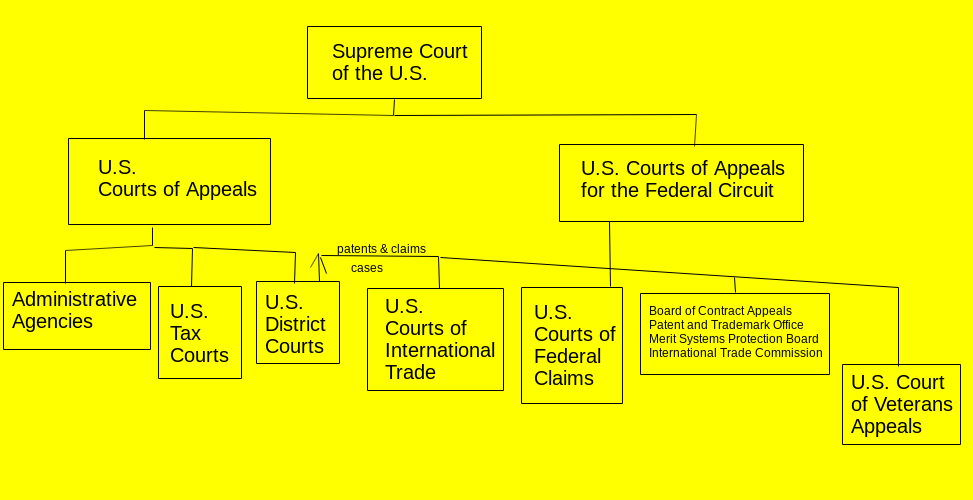
The federal courts have exclusive jurisdiction over such matters as bankruptcy, claims against the United States, and patent and copyright cases. Federal courts (see illustration 1) include:
  1. Special federal courts
  2.  Federal district courts
  3.  Federal courts of appeals
  4.  United States Supreme Court
Illustration 1 The Federal Court System

Image result for themis

Special federal courts. The special federal courts are limited in their jurisdiction by the laws of Congress creating them. For example, the Court of International Trade hears cases involving the rates of duty on various classes of imported goods, the collection of the revenues, and similar controversies. The U.S. Court of Federal Claims hears cases involving claims against the U.S. government. The Tax Court hears only cases involving tax controversies. Bankruptcy courts decide bankruptcy cases. Most bankruptcy appeals are to a three-judge appellate panel of bankruptcy judges.

Federal District Courts. By far the largest class of federal courts consists of the almost 100 federal district courts. These courts are strictly trial courts in which all criminal cases involving a violation of the federal law are tried. The district courts also have jurisdiction over civil suits that: (1) are brought by the United States; (2) arise under the U.S. Constitution, federal laws, or treaties; or (3) are brought by citizens of different states---called diversity jurisdiction---or between citizens of one state and a foreign nation or one of its citizens where the amount in controversy is $75,000 or more. 

Federal Courts of Appeals. The United States is divided geographically into 12 federal judicial circuits. Each circuit has a court of appeals, which hears appeals from cases arising in its circuit. The federal courts of appeals hear appeals from federal district courts and from federal administrative agencies and departments. A decision of a federal court of appeals is binding upon all lower courts within the jurisdiction of that circuit.

It is possible that one court of appeals could decide an issue one way and another court of appeals could decide it in another way. Because the lower courts within each court of appeals jurisdiction must follow the decision of its court of appeals, courts in different circuits might decide similar cases differently. When this occurs, there is a conflict between the circuits. The conflict lasts until one circuit changes its decision or the U.S. Supreme Court rules on the issue.

There is also another court of appeals called the court of appeals for the federal circuit. It reviews decisions of special federal courts such as the Court of International Trade and the U.S. Court of Federal Claims, decisions of four administrative agencies, and appeals from district courts in patent and claims cases.

Image result for themis

United States Supreme Court. The Supreme Court of the United States has original jurisdiction in cases affecting ambassadors, public ministers, and consuls, and in cases in which a state is a party. It has appellate jurisdiction in cases based on the U.S. Constitution, a federal law, or a treaty.

The majority of cases heard by the U.S. Supreme Court are cases appealed from the federal courts of appeals. Under certain circumstances a decision of a federal district court may be appealed directly to the Supreme Court. A state supreme court decision may also be reviewed by the U.S. Supreme Court if the case involves a federal constitutional question or if a federal law or treaty has been held invalid by the state court. Unlike the courts of appeals, the Supreme Court does not have to take all cases appealed. It chooses which appealed cases it will hear.

The normal way a case gets to the Supreme Court is by application for a writ of certiorari (to be more fully informed). The party asking for the Supreme Court review of a case asks the court to issue a writ of certiorari, which requires the lower court that has decided the case to produce the record of the case for the Supreme Court's review. The court issues a writ for only a small number of the requests.

The U.S. Supreme Court is the highest tribunal in the land, and its decisions are binding on all other courts. Its decisions are final until the court reverses its own decision or until the effect of a given decision is changed by a constitutional amendment or an enactment by Congress. The Constitution created the Supreme Court and gave Congress the power to establish inferior courts.

State Courts

State courts (see Illustration 2) can best be classified into the following groups: 
  1. Inferior courts
  2.  Courts of original general jurisdiction
  3.  Appellate courts
  4.  Special courts 

Illustration 2 Typical State Court System

Inferior Courts. Most states have inferior courts that hear cases involving minor criminal offenses and minor disputes between citizens. The names of inferior courts vary greatly from state to state. These courts are most frequently called district, magistrate, county, municipal, small claims, justice, or even taxi courts. Some states have more than one of these named courts. Civil jurisdiction is limited to controversies involving a maximum amount of money which generally varies from $1,000 to $25,000, or to a particular type of controversy. In addition, these courts may try all criminal cases involving misdemeanors. The loser in any of these courts may normally appeal to a court of original general jurisdiction.

Image result for themis

Courts of Original General Jurisdiction. Courts of original general jurisdiction are the most important courts of the state for the average citizen. These courts have broad jurisdiction over disputes between two or more parties as well as criminal offences against the state. They are called courts of original general jurisdiction because the case is first instituted in them. On occasion they hear appeals from inferior courts, but this does not make them true appellate bodies because the entire case is retried at this level. Thus, such an appeal is actually treated as a case of original jurisdiction. These courts are also called trial courts because they hear witnesses, receive evidence, and try the case.

An official, permanent record is kept of the trial showing the testimony, evidence, statements of counsel and the judge, the judgment, and the findings of the court. For this reason these courts are referred to as courts of record. The official name of such a court of original general jurisdiction varies from state to state, but in almost every state is one of the following: circuit court, district court, or superior court.

Appellate Courts. All states provide for an appeal to an appellate court by the party dissatisfied with the final judgment of the trial court or any of its rulings and instructions. Most states have a system of intermediate appellate courts, usually called courts of appeals, as well as one final appellate court. Decisions of the appellate courts bind lower courts. The state supreme court is usually the highest appellate court of a state.

Image result for themis

Special courts. Many states have additional special courts, such as probate courts that handle wills and estates; juvenile courts that are concerned with delinquent, dependent, and neglected children; and domestic relations courts that handle divorce and child custody cases. These are not courts of general jurisdiction, but of special jurisdiction. In some states these courts are on the same level as the trial courts. If this is the case, they are properly called trial courts and are courts of record. In other states they are on the same level as the inferior courts and are not courts of record.

*SOURCE: LAW FOR BUSINESS, 15TH ED., 2005, JANET E. ASHCROFT, J.D. PGS. 11-17* 

end

Sunday, October 6, 2019

Public Relations: An Economic Perspective (part 2 - The Podcast)

Image result for the rant with charles lamson

Click here.

Business Law (part 2)


Introduction to Law (part B)
 by
 Charles Lamson

Civil Versus Criminal Law

 Law may be classified as either civil or criminal. A person may file a lawsuit in order to enforce or protect a private right by requesting compensation for damage suffered or other action for restoration of his or her property. This action in civil law is concerned with private or purely personal rights.


Criminal law is that branch of the law dealing with crimes and the punishment of wrongdoers. A crime is an offense that tends to injure society as a whole. A criminal action differs from a civil action in that an employee of the government---usually called the prosecutor or district attorney brings a criminal action. The standard of proof required is greater than in a civil case. A person can be convicted of a crime only if proven guilty "beyond a reasonable doubt." If a person accused of a crime is subject to the penalty of imprisonment, the accused has a right to an attorney even if he or she cannot pay for one. In addition, the constitutional prohibition against double jeopardy means that a person can only be tried for a crime once. This protection is not absolute since it allows for retrial, for example, if a conviction is overturned or if there is no decision in a first trial. 

Historically, crimes are usually classified, according to the nature of the punishment provided, as felonies or misdemeanors. Generally speaking, felonies are the more serious crimes and are usually punishable by death or by imprisonment in a penitentiary or state prison for more than one year. Misdemeanors are offenses of a less serious character and are punishable by a fine or imprisonment  in a county or local jail. Forgery is a felony, but disorderly conduct and unauthorized entry of a dwelling are misdemeanors. 

Some offences carry penalties that can be either misdemeanor penalties or felony penalties. These offences are called wobblers. In the case of wobblers, if the punishment imposed is more than a year of imprisonment the offense is a felony. If the punishment is less than a year of imprisonment the offense is a misdemeanor.

Image result for themis

Because there are some offenses punished by government that are not considered serious offences and therefore do not carry severe penalties, a number of states have established a third level of offense. These offences are at a level below that of misdemeanors and might be called violations or infractions. An infraction could be making an illegal U-turn while driving or speeding. In some states, violations or infractions might not even be considered criminal offenses. They would carry penalties of a fine or imprisonment, but only in a local jail for a few days. Obviously, criminal statutes vary somewhat from state to state. 

Tort Law

A tort is a private or civil wrong or injury for which there may be an action for damages. A tort may be intentional or it may be caused by negligence. Negligence is the failure to exercise reasonable care towards someone. It is tort law that allows an innocent motorist who is the victim of a careless or negligent driver to sue the negligent driver for damages. Other torts include fraud, trespass, assault, slander, and interference with contract. A tort action must be brought by the injured person against the personal alleged to be negligent.

Ethics

These last couple posts discussed the basis for laws. One of the most important ideas mentioned is that "laws are the result of societies changing concept of what is right and what is wrong." That means laws are based on our judgment regarding what human conduct is right, and therefore should be encouraged, and what kind of conduct is wrong, and therefore should be discouraged. We thus base our laws on our morals. These principles that help a person determine the morality of conduct, its motives, and its duties are called our ethics.

Image result for themis

Bases for Ethical Judgement

Everyone has opinions on what behavior and thinking is right and what is wrong, basing these ethical judgments on personal values. We develop our values from our religious beliefs, our experience, our cultural background, and our scientific knowledge. Since people have differing backgrounds, our judgments as to what is right and wrong vary somewhat.

Ethical Principles

And considering how ethics relates to the law, several principles regarding the application of ethics emerge. These principles include:
  1. Seriousness of the consequences
  2.  Consensus of the majority
  3.  Change in ethical standards

Seriousness of consequences. Although law is based on what we believe is right and wrong, our laws do not reflect everything we believe is right or wrong. When unethical behavior can harm others---when the matter is of serious consequence to people---laws are usually enacted to regulate that behavior. Less serious matters can be considered wrong, but laws do not address them. For example, rules of etiquette frequently reflect our ethical judgments about behavior, but they do not have serious enough consequences that we passed laws to enforce them.

Consensus of the majority. Our laws cannot express every individual's ethical principles since everyone does not agree on what is moral. There may be no law or reflecting of judgment on a particular matter, or the laws might reflect the judgment of some. For example, vegetarians and non-drinkers may not believe laws permitting the eating of meat or the consumption of alcoholic beverages are ethical. Their morality may not be reflected in law. In a democratic society such as ours, the laws are designed to reflect the ethical view of the majority.

Change In ethical standards. Ethical standards change over time. Behavior believed ethical in the past becomes unethical, and behavior previously viewed as immoral becomes acceptable. Consider the matter of cigarette smoking on airplanes. Many years ago airline passengers could smoke no matter where they were seated. Then the law mandated smoking and non-smoking sections on planes. Now all commercial airlines in the United States prohibit smoking in all sections and the federal government uses the force of law to enforce this rule. This change in government rules reflects the change in the view of most people about the harmful effects of cigarette smoking. Our ethical standards have changed and this is reflected in the law. 

Business Ethics

Our ethical standards apply to every to every aspect of life. For businesspeople, this means that ethical standards help determine their business practices. In our competitive economic system, the standard people in business have been expected to follow in determining behavior is "the bottom line." Is the behavior something that will help the business financially? When studying ethics as applied to business, we ask, does a business have obligations other than simply to make a profit or maximize the bottom line?

Many types of businesses or professional organizations have adopted codes of ethics to guide the behavior of their members. Variety occurs not only in the types of business that have adopted such codes, but also in the impact of the codes on business. Some codes are legally enforceable, technically making them laws, not ethical rules. Other codes are strictly voluntary and are thus truly rules of ethics.

Legally enforceable. A number of professions that have codes of ethics, usually called codes of professional responsibility, which when violated provide the basis for penalties against members of the profession. For example, the American Bar Association has produced a model code and model rules for ethical Behavior by lawyers. Although these particular models have not been adopted by every state, each state has adopted an ethical code for lawyers. A violation of legal ethics subject a lawyer to discipline, including suspension from practicing law or even disbarment.

Image result for themis

Voluntary. Some businesses have adopted codes of ethics for themselves as guides for individuals employed in these businesses. Since government has not imposed the codes, they do not carry legal penalties for violation. However employees who violate ethical codes subject themselves to discipline by their employers. The codes recognize that ethical business conduct is a higher standard than that required by law and encourage behavior that is fair, honest, and, if disclosed, not embarrassing to the individual or the business.

The need for ethical practices, particularly in business is greater than ever. The demand for such ethical behavior is so great that we often see it reflected in new legislation. If the public is not confident that businesses will comply with their ethical responsibilities, we will undoubtedly see more and more legislation asking business to rise to ethical rather than just the previously legal standards.

*SOURCE: LAW FOR BUSINESS, 15TH ED., 2005, JANET E. ASHCROFT, PGS. 6-9* 

end

Friday, October 4, 2019

Business Law (part 1)


Introduction to Law
 by
 Charles Lamson

Many authors have tried to define law. Blackstone's definition is famous: "Law is a rule of civil conduct, commanding what is right and prohibiting what is wrong." Many rules of civil conduct command what is right and condemned what is wrong, but rules are not necessarily laws. Only when a sovereign state issues rules prescribing what is right and what is wrong can a rule be called the law. Even then rules are not effective unless penalties are applied when the rules are broken. Thus the law is a rule that prescribes conduct and that is enacted and enforced by a government.

Image result for themis

Religious teachings, social mores, habit, and peer pressure all contribute to social control of conduct, but only the rules of law are all pervasive, applying with equal force to every member of society. A breach of some of these rules is a crime, for which the penalty is a fine, a jail sentence, or both. A breach of other rules is a civil wrong, for which the penalty most often is payment of a sum of money called damages.

Business law is a class of laws that are concerned primarily with rules of conduct prescribed by government for the performance of business transactions. The laws governing business transactions in the United States did not come into existence overnight. Laws result from society's changing concept of what is right and what is wrong. Laws may be created or modified to deal with new technology or circumstances. For example, for several centuries in England and America and individual who owned land owned the soil and minerals below the topsoil and the air above the land "all the way to heaven." The law prohibited trespassing on a person's land or air. A telephone company that wanted to string a telephone wire through the air had to buy a right of way. When airplanes were invented, this law became a millstone around society's neck. Under this law, a transcontinental airline would have to buy a right of way through the air of every property owner in its path from New York to San Francisco. The modification of this rule by judicial decree shows how the law changes when circumstances change. 

Objectives of Law

We Live in a complex society. Every time we have business dealings with others---working, making a purchase, starting a business, traveling, renting an apartment, or trying to insure against loss---we have the potential for a dispute. The law seeks to establish rules so that we will be able to resolve those disputes that arise. The law also sets the rules of conduct for many transactions so we will know how to avoid disputes. The law of thus tries to establish a stable framework to keep Society operating as smoothly as possible.

Image result for themis

Roots of our Legal System

When the European colonists settled in this country, they instituted legal systems similar to what they had in their native lands. Therefore English, French, and Spanish colonists set up legal systems similar to those in England, France, and Spain. The 13 colonies that originally became the United States where all English colonies, so they adopted a legal system like England's. Although additional territory was added and the influence of other legal systems was felt, the system we have today is still based heavily on the English legal system of common law and equity.

The Common Law

Common law is custom that has come to be recognized by the courts as binding on the community and therefore law. In medieval England, there were no laws prescribing the proper rule of conduct in hundreds of situations. When a dispute came before a judge, the court prescribed a rule of its own based on the customs of the time. Over a period of several centuries, these court decisions developed into a body of law. The colonists brought this body of law from England to America. After the United States became a sovereign nation, most  of these common laws are either enacted as statutory laws or continued as judge-made laws. Much of our current law is based on this common law. 

Equity

Uniformity and the common law spread throughout England because judges tended to decide cases the same way other judges had decided them. But some wrongs occurred for which law provided no remedy except for money damages. In some cases, this was not an appropriate remedy. To obtain suitable relief, individuals began to petition the king for justice. The king delegated these matters to the chancellor, who did not decide the cases on the basis of recognized legal principles, but on the basis of equity---what in good conscience ought to be done. Eventually an additional system of justice evolved that granted judicial relief when no adequate remedy at law existed. This system is called equity.


Courts of equity, although they sometimes recognize legal rights, also provided new types of relief. For example, instead of merely ordering a person who had breached a contract agreeing to sell real estate to pay money damages, they would order "specific performance"---that is, require the seller to comply with the terms of the contract and sell the real estate. They also provided for preventative action to protect individuals from likely harm. In this type of case a court with equity powers might initially issue a restraining order, a temporary order forbidding a certain action. Upon a complete hearing, the court might issue an injunction, a permanent order forbidding activities that would be detrimental to others. Today only a few states maintain separate equity courts or, as they are also called, chancery courts. In most states, courts apply legal and equitable principles to each case as the facts justify, without making any formal distinction between law and equity.

Image result for themis

Sources of Law

Our laws come from several sources. They include judges' decisions, federal and state constitutions, statutes, and administrative agency orders.

Judicial Decisions

Judicial interpretation is an important element of the legal process. Because courts can interpret laws differently, the same law might have someone different consequences in different states. Interpretations by the highest courts have the effect of setting precedents. A precedent is a decided case or court decision that determines the decision in a subsequent case because the cases are so similar. Under the doctrine of stare decisis (stand by the decision) these precedents bind the lower courts. These interpretations may concern a situation not previously brought before the court, or the court may decide to reverse a previous decision. Any state supreme court or the Supreme Court of the United States can reverse a decision of a lower court. For the legal stability and so that we can know our rights before we undertake a transaction, courts must generally adhere to the judicial precedents set by earlier decisions. However, changing situations or practices sometimes make it necessary for the previous case law to be overturned and the new rule or practice to be established. 

Constitution

A constitution is the document that defines the relationships of the parts of the government to each other and the relationship of the government to its citizens or subjects. The U.S. Constitution is the supreme law of the land. State constitutions, as well as all other laws, must agree with the U.S. Constitution. The Supreme Court of the United States is the final arbiter and disputes about whether a state or federal law violates the US Constitution. A state supreme court is the final judge as to whether a state law violates the constitution of that state.

In 1791, after the U.S. Constitution had been adopted, it was amended by the addition of the Bill of Rights. The Constitution contained no specific guarantees of individual liberty. The Bill of Rights consists of 10 Amendments specifically designed to protect the civil rights and liberties of the citizens and the states. It is a part of the U.S. Constitution. Frequently, rights protected by the Bill of Rights are referred to by the number of the amendment in which they can be found. Most people have heard of First Amendment rights to free speech or fifth amendment rights against self-incrimination.

Image result for themis

Statutes

Statutes are laws enacted by legislative bodies. The federal Congress, state legislatures, and city councils, all composed of persons elected by the voters, comprise the three chief classes of legislative bodies in the United States. Cities and other municipalities make laws usually called ordinances, a specific type of statutory law.

In some cases, statutes enacted by one legislative body conflict with statutes enacted by another legislative body. Statutes enacted by a higher legislative body prevail over those of lower legislative bodies. Thus a state law prevails over conflicting county or municipal legislation. A constitutional federal statute prevails over a conflicting state statute.

Unlike constitutions, which are difficult to amend and are designed to be general rather than specific, statutes may be and enacted, repealed, or amended at any regular or special session of the lawmaking body. Thus statues respond more to the changing demands of the people.

In the field of business law the most important statute is the Uniform Commercial Code (UCC). The UCC regulates sales and leases of goods; negotiable instruments, such as checks, secured transactions, and particular aspects of banking and fund transfers, letters of credit, warehouse receipts, bills of lading, and investment securities. Although all 50 states have enacted at least some portions of the UCC, individual states have made some changes. Therefore, variations in the UCC exist from state-to-state.

Administrative Agency Orders

Administrative agencies set up by legislative bodies carry on many governmental functions today. Administrative agencies are commissions or boards that have the power to regulate particular matters or implement laws. At the federal level alone almost 60 agencies are involved in regulatory activity. The legislative branch of government enacts laws that prescribe the powers that administrative agencies may exercise, the principles that guide the agencies in exercising those powers, and the legal remedies available to those who want to question the legality of some administrative action.

Image result for themis

Administrative agencies may be given practically the same power to make law as the legislature and almost the same power to decide cases as the courts. However, agencies are created by laws and have the power to enact laws only if that power has been delegated to them by the legislature.

The president of the United States, with the consent of the Senate, appoints the heads of federal administrative agencies. The governor appoints heads of state administrative agencies. Administrative agencies are given wide latitude in setting up rules of procedure. They issue orders and decrees that have the focus of law unless set aside by the courts after being challenged. If an agency rule conflicts with a statute, the statute takes precedence. 

*SOURCE: LAW FOR BUSINESS, 15TH ED., 2005, JANET E. ASHCROFT, J.D., PGS. 2-6*

end

Rosary from Lourdes - 02/12/2025