Mission Statement

The Rant's mission is to offer information that is useful in business administration, economics, finance, accounting, and everyday life. The mission of the People of God is to be salt of the earth and light of the world. This people is "a most sure seed of unity, hope, and salvation for the whole human race." Its destiny "is the Kingdom of God which has been begun by God himself on earth and which must be further extended until it has been brought to perfection by him at the end of time."

Sunday, January 9, 2022

Accounting: The Language of Business (Part 35)


You have to know accounting. It's the language of practical business life. It was a very useful thing to deliver to civilization. I've heard it came to civilization through Venice which of course was once the great commercial power in the Mediterranean. However, double entry bookkeeping was a hell of an invention.Charlie Munger

Accounting for Merchandising Businesses (part H)

by

Charles Lamson


Accounting Systems for Merchandisers


Merchandising companies may use either manual or computerized accounting systems, similar to those used by service businesses. In this post, we describe and illustrate special journals and electronic forms that merchandising businesses may use in these systems.


Manual Accounting System


In a manual accounting system, a merchandise business normally uses four special journals: sales journal (for sales on account), purchases journal (for purchases on account), cash receipts journal, and cash payments journal. These journals can be adapted from the special journals that we Illustrated earlier for a service business.


Exhibit 12 illustrates NetSolutions' sales journal, which is modified from a revenue journal. In a sales journal, each transaction is recorded by entering the sales amount in the Accounts Receivable Dr./Sales Cr. column and entering the cost of the merchandise sold amount in the Cost of Merchandise Sold Dr./Merchandise Inventory Cr. column. The totals of the 2 columns would be posted to the four general ledger accounts. The inventory and accounts receivable subsidiary ledgers would be updated when each transaction is recorded.


Exhibit 13 illustrates our purchases journal for NetSolutions' merchandising business. This journal is similar to the purchases journal for NetSolutions' service business that we illustrated previously. It includes an Accounts Payable Cr. column and a Merchandise Inventory Dr. column, rather than a Supplies Dr. column. At the end of the month, these two column totals would be posted to the general ledger controlling accounts, Accounts Payable and Merchandise Inventory. The amounts in Other Accounts Dr. would be posted individually. The inventory and accounts payable subsidiary ledger would be updated when each transaction is recorded.


Exhibit 14 illustrates a portion of NetSolutions cash receipts journal. In this journal, cash sales are recorded in a Sales Cr. column rather than a Fees Earned Cr. column. In addition, the cost of merchandise sold for cash is recorded in a Cost of Merchandise Sold Dr./Merchandise Inventory Cr. column. Each entry in this column is posted to the inventory subsidiary ledger at the time the transaction is recorded. Sales discounts are recorded in a Sales Discounts Dr. column. At the end of the month, all the column totals except for Other Accounts Cr. are posted to the general ledger. 


Exhibit 15 illustrates a portion of the cash payments journal for NetSolutions. This journal is modified for a merchandising business by adding a Merchandise Inventory Cr. column for recording discounts on purchases paid within the discount period. Each entry in this column is posted to the inventory subsidiary ledger at the time the transaction is recorded. At the end of the month, all the column totals except for Other Accounts Dr. are posted to the general ledger.


EXHIBIT 15 Cash Payments Journal for Merchandising Business


Computerized Accounting Systems


In computerized accounting systems, special journals may be replaced by electronic forms that capture the necessary information. The software then uses the information as the basis for making entries automatically.


*WARREN, REEVE, & FESS, 2005, ACCOUNTING, 21ST ED., PP. 252-254*


end

Friday, January 7, 2022

Feel Love, Let go of the Past | Heart Chakra Healing Meditation Music | ...

Accounting: The Language of Business (Part 34)


What you get out of an M.B.A. programme, no matter how much experience, is functional tools and understanding in disciplines: you'll understand economics, you'll understand marketing, finance, accounting. That, M.B.A. programmes do very well.

Henry Mintzberg


Accounting for Merchandising Businesses

(Part G)

by

Charles Lamson


The Accounting Cycle for a Merchandising Business


In preceding posts, we described and illustrated the chart of accounts and the analysis and recording of transactions for a merchandising business. We have also illustrated the preparation of financial statements for a merchandiser, NetSolutions, at the end of an accounting cycle. In the next several posts, we describe the other elements of the accounting cycle for a merchandising business. In this discussion, we will focus primarily on the elements of this cycle that are likely to differ from those of a service business.


Merchandise Inventory Shrinkage


Under the perpetual inventory system, a separate merchandise inventory account is maintained in the ledger. During the accounting period, this account shows the amount of merchandise for sale at any time. However, merchandising businesses may experience some loss of inventory due to shoplifting, employee theft, or errors in recording or counting inventory. As a result, the physical inventory taken at the end of the accounting period may differ from the amount of inventory shown in the inventory records. Normally, the amount of merchandise for sale, as indicated by the balance of the merchandise inventory account, is larger than the total amount of merchandise counted during the physical inventory. For this reason, the difference is often called inventory shrinkage or inventory shortage.


To illustrate, NetSolutions' inventory records indicate that $63,950 of merchandise should be available for sale on December 31, 2025. The physical inventory taken on December 31, 2025, however, indicates that only $62,150 of merchandise is actually available. Thus, the inventory shrinkage for the year ending December 31, 2025, is $1,800 ($63,950 - $62,150). This amount is recorded by the following adjusting entry:


After this entry has been recorded, the accounting records agree with the actual physical inventory at the end of the period. Since no system of procedures and safeguards can totally eliminate it, inventory shrinkage is often considered a normal cost of operations. If the amount of the shrinkage is abnormally large, it may be disclosed separately on the income statement. In such cases, the shrinkage may be recorded in a separate account, such as Loss from Merchandise Inventory Shrinkage.


Work Sheet


Merchandising businesses that use a perpetual inventory system are also likely to use a computerized accounting system. In a computerized system, the adjusting entries are recorded and the financial statements prepared without using a worksheet. For this reason, we illustrate the worksheet and the adjusting entries for NetSolutions in part 36.


Closing Entries


The closing entries for a merchandising business are similar to those for a service business. The first entry closes the temporary accounts with credit balances, such as Sales, to the income summary account. The second entry closes the temporary accounts with debit balances, including Sales Returns and Allowances, Sales Discounts, and Cost of Merchandise Sold, to the income summary account. The third entry closes the balance of the income summary account to the owner's capital account. The fourth entry closes the owner's drawing account to the owner's capital account.


In a computerized accounting system, the closing entries are prepared automatically. For this reason, we illustrate the closing entries for NetSolutions in part 36.


*WARREN, REEVE, & FESS, 2005, ACCOUNTING, 21ST ED., PP. 250-251*


end

Thursday, January 6, 2022

Heart Chakra Healing Meditation , Renew Self-Love and Self-Esteem

Accounting: The Language of Business (Part 33)


For generations of Hong Kongers, the only means of upward mobility and the only way to meaningfully contribute to society have been to obtain a respectable university degree (preferably in business administration) and a professional accreditation (in finance, accounting, law or medicine).

Joshua Wong


Accounting for Merchandising Businesses

(Part F)

by

Charles Lamson


Transportation Costs, Sales Taxes, and Trade Discounts


In the preceding two posts, we described and illustrated merchandise transactions involving sales and purchases. In this post, we discuss merchandise transactions involving transportation costs, sales taxes, and trade discounts. 


Transportation Costs


The terms of a sale should indicate when the ownership (title) of the merchandise passes to the buyer. This point determines which party, the buyer or the seller, must pay the transportation costs.


The ownership of the merchandise may pass to the buyer when the seller delivers the merchandise to the transportation company or freight carrier. For example, Chrysler records the sale and the transfer of ownership of its vehicles to dealers when the vehicles are shipped from the factory. In this case, the terms are said to be FOB (free-on-board) shipping point. This term means that the dealer pays the transportation costs from the shipping point (factory) to the final destination. Such costs are part of the dealer's total cost of purchasing inventory and should be added to the cost of the inventory by debiting Merchandise Inventory.


To illustrate, assume that on June 10, NetSolutions buys merchandise from Magna Data on account, $900, terms FOB shipping point, and pays the transportation cost of $50. NetSolutions records these two transactions as follows:


The ownership of the merchandise may pass to the buyer when the buyer receives the merchandise. In this case, the terms are said to be FOB (free-on-board) destination. This term means that the seller delivers the merchandise to the buyer's final destination, free of transportation charges to the buyer. The seller thus pays the transportation costs to the final destination. The seller debits Transportation Out or Delivery Expense, which is reported on the seller's income statement as an expense.  


To illustrate, assume that on June 15, NetSolutions sells merchandise to Kranz Company on account, $700, terms FOB destination. The cost of the merchandise sold is $480, and NetSolutions pays the transportation cost of $40. NetSolutions records the sale, the cost of the sale, and the transportation cost as follows:


As a convenience to the buyer, the seller may prepay the transportation costs, even though the terms are FOB shipping point. The seller will then add the transportation cost to the invoice. The buyer will debit merchandise inventory for the total amount of the invoice, including the transportation costs. Any discount terms would not apply to the prepaid transportation costs.


To illustrate, assume that on June 28, NetSolutions sells merchandise to Planter Company on account, $800, terms FOB shipping point. NetSolutions pays the transportation cost of $45 and adds it to the invoice. The cost of the merchandise sold is $360. NetSolutions records these transactions as follows:


Shipping terms, the passage of title, and whether the buyer or seller is to pay the transportation costs are summarized in Exhibit 10.


Sales Taxes


Almost all states and many other taxing units levy a tax on sales of merchandise. The liability for the sales tax is incurred when the sale is made.


At the time of a cash sale, the seller collects the sales tax. When a sale is made on account, the seller charges the tax to the buyer by debiting Accounts Receivable. The seller credits the sales account for the amount of the sale and credits the tax to Sales Tax Payable. For example, the seller would record a sale of $100 on account, subject to a tax of 6%, as follows:


Normally on a regular basis, the seller pays to the taxing unit the amount of the sales tax collected. The seller records such a payment as follows:


Trade Discounts


Wholesalers are businesses that sell merchandise to other businesses rather than to the general public. Many wholesalers publish catalogs. Rather than updating their catalogs frequently, wholesalers often publish price updates, which may involve large discounts from the list prices in their catalogs. In addition, wholesalers may offer special discounts to certain classes of buyers, such as government agencies or businesses that order large quantities. Such discounts are called trade discounts.


Sellers and buyers do not normally record the list prices of merchandise and the related trade discounts in their accounts. For example, assume that an item has a list price of $1,000 and a 40% trade discount. The seller records the sale of the item at $600 [$1,000 less the trade discount of $400 ($1,000 * 40%)]. Likewise, the buyer records the purchase at $600. 


*WARREN, REEVE, & FESS, 2005, ACCOUNTING, 12TH ED., PP. 245-248*


end

Tuesday, January 4, 2022

Fu Manchu - Godzilla's/Eatin' Dust (Full Album)

Build Back Better: Navigating the Great Reset through Control of the Gre...

Accounting: The Language of Business (Part 32)


The scriptures make the danger of delay clear. It is that we may discover that we have run out of time. The God who gives us each day as a treasure will require an accounting.

Henry B. Eyring


Accounting for Merchandising Businesses

(Part E)

by

Charles Lamson


Purchase Transactions


As indicated in an earlier post, most large retailers and many small merchandising businesses use computerized perpetual inventory systems. Under the perpetual inventory system, cash purchases of merchandise are recorded as follows:


Purchases of merchandise on account are recorded as follows:


Purchases Discounts


Purchases discounts taken by the buyer for early payment of an invoice reduce the cost of the merchandise purchased. Most businesses design their accounting systems so that all available discounts are taken. Even if the buyer has to borrow to make the payment within a discount, it is normally to the buyer's advantage to do so. To illustrate, assume that Alpha Technologies issues an invoice for $3,000 to NetSolutions, dated March 12, with terms 2/10, n/30 (2% discount if paid within 10 days, net amount due within 30 days). The last day of the discount. In which the $60 discount can be taken is March 22. Assume that in order to pay the invoice on March 22, NetSolutions borrows the money for the remaining 20 days of the credit period. If we assume an annual interest rate of 6% and a 360-day year (A calendar year with 365 or 366 days does not divide evenly across the 12 months so it became standard practice to record interest on accounts payable using a 360-day year, treating each month as 30 days. This method of calculating interest is called the accrual convention.), the interest on the loan of $2,940 ($3,000 - $60) is $9.80 ($2,940 * 6% X 20 / 360). The net savings to NetSolutions is $50.20, computed as follows:


The savings can also be seen by comparing the interest rate on the money saved by taking the discount and the interest rate on the money borrowed to take the discount. For NetSolutions, the interest rate on the money saved in this example is estimated by converting 2% for 20 days to a yearly rate, as follows:


If NetSolutions borrows the money to take the discount, it pays interest of 6%. If NetSolutions does not take the discount, it pays estimated interest of 36% for using the $60 for an additional 20 days.


Under the perpetual inventory system, the buyer initially debits the merchandise inventory account for the amount of the invoice. When paying the invoice, the buyer credits the merchandise inventory account for the amount of the discount. In this way, the merchandise inventory shows the net cost to the buyer. For example, Netsolutions would record the Alpha Technologies invoice and it's payment at the end of the discount period as follows:


If NetSolutions does not take the discount because it does not pay the invoice until April 11, it would record the payment as follows:


Purchases Returns and Allowances


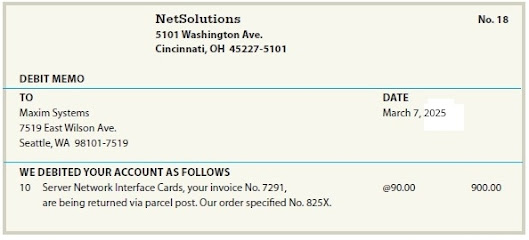
When merchandise is returned (purchases return) or a price adjustment is requested (purchases allowance) , the buyer (debtor) usually sends the seller a letter or a debit memorandum. A debit memorandum, shown in Exhibit 9, informs the seller of the amount the buyer proposes to debit to the account payable due the seller. It also states the reasons for the return or the request for a price reduction.


EXHIBIT 9 Debit Memorandum


The buyer may use a copy of the debit memorandum as the basis for recording the return or allowance or wait for approval from the seller (creditor). In either case, the buyer must debit Accounts Payable and credit Merchandise Inventory. To illustrate, NetSolutions records the return of the merchandise indicated in the debit memo in Exhibit 9 as follows:


When a buyer returns merchandise or has been granted an allowance prior to paying the invoice, the amount of the debit memorandum is deducted from the invoice amount. The amount is deducted before the purchase discount is computed. For example, assume that on May 2, NetSolutions purchases $5,000 of merchandise from Delta Data Link, subject to terms 2/10, n/30. On May 4, NetSolutions returns $3,000 of the merchandise, and on May 12, NetSolutions pays the original invoice less the return. NetSolutions would record these transactions as follows: 


*WARREN, REEVE, & FESS, 2005, ACCOUNTING, 21ST ED., PP. 242-244*


end

Saturday, January 1, 2022

Enchanted Forest Music (528Hz) : Brings Positive Transformation | Mystic...

Accounting: The Language of Business (Part 31)


It's really amazing that in the age of unbelief, as a smart man called it, there isn't even more fraud. After all, with no God, there's no one to ever call you to account, and no accounting at all if you can get away with it.

Ben Stein


Accounting for Merchandising Businesses

(Part D)

by

Charles Lamson


Sales Discounts


The terms of a sale are normally indicated on the invoice or bill that the seller sends to the buyer. An example of a sales invoice for NetSolutions is shown in Exhibit 6.


EXHIBIT 6 Invoice


The terms for when payments for merchandise are to be made, agreed on by the buyer and the seller, are called the credit terms. If payment is required on delivery, the terms are cash or net cash. Otherwise, the buyer is allowed an amount of time, known as the credit period, in which to pay.


The credit period usually begins with the date of the sale as shown on the invoice. If payment is due within a stated number of days after the date of the invoice, such as 30 days, the terms are net 30 days. These terms may be written as n/30. If payment is due by the end of the month in which the sale was made, the terms are written as n/com.


As a means of encouraging the buyer to pay before the end of the credit period, the seller may offer a discount. For example, a seller may offer a 2% discount if the buyer pays within 10 days of the invoice date. If the buyer does not take the discount, the total amount is due within 30 days. These terms are expressed as 2/10, n/30 and are read as 2% discount if paid within 10 days, net amount due within 30 days. The credit terms of 2/10, n/30 are summarized in Exhibit 7, using the information from the invoice in Exhibit 6.


EXHIBIT 7 Credit Terms


Discounts taken by the buyer for early payment are recorded as sales discounts by the seller. Since managers may want to know the amount of the sales discounts for a period, the seller normally records the sales discounts in a separate account. The sales discounts account is a contra (or offsetting) account to Sales. To illustrate, assume that cash is received within the discount period (10 days) from the credit sale of $1,500, shown on the invoice in Exhibit 6. NetSolutions would record the receipt of the cash as follows:


Sales Returns and Allowances


The merchandise sold may be returned to the seller (sales return). In addition, because of defects or for other reasons, the seller may reduce the initial price at which the goods were sold (sales allowance). If the return or allowance is for a sale on account, the seller usually issues the buyer a credit memorandum. This memorandum shows the amount of and the reason for the sellers credit to an account receivable. A credit memorandum issued by NetSolutions is illustrated in Exhibit 8.


EXHIBIT 8 Credit Memorandum


Like sales discounts, sales returns and allowances reduce sales revenue. They also result in additional shipping and other expenses. Since managers often want to know the amount of returns and allowances for a period, the seller records sales returns and allowances in a separate account. Sales returns and allowances is a contra (or offsetting) account to sales.


The seller debits Sales Returns and Allowances for the amount of the return or allowance. If the original sale was on account, the seller credits Accounts Receivable. Since the merchandise inventory is kept up to date in a perpetual system, the seller adds the cost of the returned merchandise to the merchandise inventory account. The seller must also credit the cost of returned merchandise to the cost of merchandise sold account, since this account was debited when the original sale was recorded. To illustrate, assume that the cost of the merchandise returned in Exhibit 8 was $140. NetSolutions records the credit memo in Exhibit 8 as follows:


What if the buyer pays for the merchandise and the merchandise is later returned? In this case, the seller may issue a credit and apply it against other accounts receivable owed by the buyer, or the cash may be refunded. If the credit is applied against the buyer's other receivables, the seller records entries similar to those preceeding. If cash is refunded for merchandise returned or for an allowance, the seller debits Sales Returns and Allowances and credits Cash.


*WARREN, REEVE, & FESS, 2005, ACCOUNTING, 21ST ED., PP. 239-242*


end

Rosary from Lourdes - 02/12/2025