Mission Statement

The Rant's mission is to offer information that is useful in business administration, economics, finance, accounting, and everyday life. The mission of the People of God is to be salt of the earth and light of the world. This people is "a most sure seed of unity, hope, and salvation for the whole human race." Its destiny "is the Kingdom of God which has been begun by God himself on earth and which must be further extended until it has been brought to perfection by him at the end of time."

Wednesday, September 19, 2018

Personal Financial Planning: A "How-To" Guide (part 10)


The Income and Expense Statement: 
What We Earn and Where It Goes
by
Charles Lamson

Where does all the money go? Preparing an income and expense statement would provide this answer. Whereas the balance sheet (from last post) describes a person's or family's financial position at a given point in time, the income and expense statement captures the various financial activities that have occurred over time---normally over the course of a year, although it technically can cover any time period (month, quarter, and so on). Think of this statement as a motion picture that not only shows actual results over time but also allows you to compare them with budgeted financial goals as well. Equally important, the statement allows you to evaluate the amount of saving and investing during the period it covers.

Image result for the missouri river

Image result for personal balance sheet template
Worksheet 1 
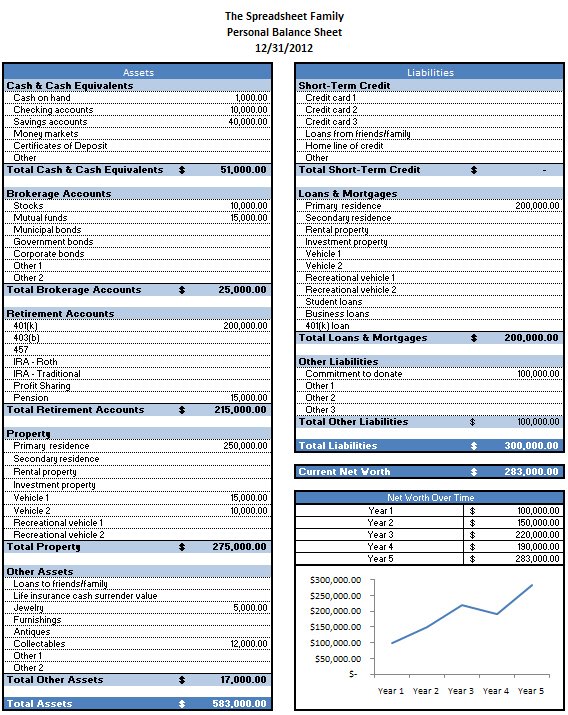
Sample personal balance sheet (from last post)

Like the balance sheet (from last post - see Worksheet 1), the income and expense statement (Worksheet 2) has three major parts: income, expenses, and cash surplus (or deficit). A cash surplus (or deficit) is merely the difference between income and expenses. The statement is prepared on a cash basis, which means that only transactions involving actual cash receipts or actual cash outlays (an amount of money that you spend on something, especially a large amount that is spent on new equipment or to start a new business activity) are recorded. The term cash is used in this case to include not only coin and currency but also checks drawn against demand deposits and certain types of savings accounts.
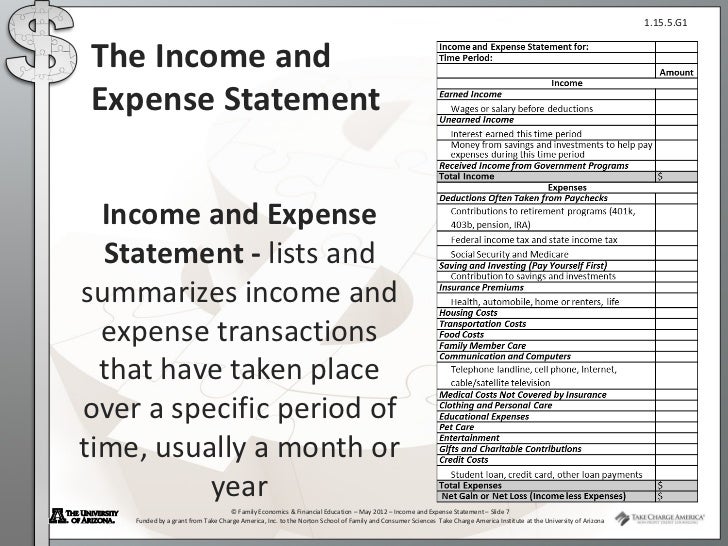
Image result for income and expense statement
Worksheet 2
The income and expense statement.

Income and expense patterns change over the individual's or family's life cycle. Income and spending levels rise steadily to a peak in the 45-54 age bracket. On average, persons in this age group, whose children are typically in college or no longer at home, generally have the highest level of income. They also spend more than other age groups on entertainment, dining out, transportation, education, insurance, and charitable contributions. Families in the 35-44 age bracket have slightly lower average levels of income and expenses but very different spending patterns. Because they tend to have school-age children, they spend more on groceries, housing, clothing, and other personal needs.

Related image

Income: Cash In

Common sources of income include earnings received as wages, salaries, self-employment, bonuses, and commissions; interest and dividends received from savings and investments; and proceeds from the sale of assets, such as stocks or bonds or an auto. Other income items include pension or annuity income; rent received from leased assets; alimony and child support; scholarships, grants, and Social Security received; tax refunds; and miscellaneous types of income. Worksheet 2 (above) has general categories to record your income.

Note also that the proper figure to use is gross wages, salaries, and commissions, which constitute the amount of income you receive from your employer before taxes and other payroll deductions. The gross value is used because the taxes and payroll deductions will be itemized and deducted as expenses later in the income and expense statement. Therefore, you should not use take-home pay, because it will understate your income by the amount of these deductions.


Expenses: Cash Out

Expenses represent money used for outlays. Worksheet 2 categorizes them by the types of benefits they provide: (1) living expenses (such as housing, utilities, food, transportation, medical, clothing and insurance), (2) tax payments, (3) asset purchases (such as autos, stereos, furniture, appliances, and loan payments on them), and (4) debt payments (on mortgages, installment loans, credit cards, and so on). Some are fixed expenses, which are usually contractual, predetermined, and involve equal payments each period (typically each moth). Examples include mortgage and installment loan payments, insurance premiums, professional or union dues, club dues, monthly savings, or investment programs, and cable television fees. Others (such as food, clothing, utilities, entertainment, and medical expenses) are variable expenses, because their amounts change from one time period to the next.

Related image

Your expenses will vary according to your age, lifestyle, and where you live. For example, it costs considerably more to buy a home in San Diego than in Indianapolis. If you live in the suberbs, your continuing expenses will be higher than those of city dwellers.

Smart.sites

For current surveys and trends on consumer spending, check out the Consumer Expenditures Survey at the Department of Labor’s Bureau of Labor Statistics site, https://www.bls.gov/news.release/pdf/cesan.pdf.

Cash Surplus (Or Deficit)

The third component of the income and expense statement shows the net result of the period's financial activities. Subtracting total expenses from total income gives you the cash surplus (or deficit) for the period. At a glance, you can see how you did financially over the period. A positive figure indicates that expenses were less than income, resulting in a cash surplus. A value of zero indicates that expenses were exactly equal to income for the period, while a negative value means that your expenses exceeded income and you have a cash deficit.

You can use a cash surplus for savings or investment purposes, to acquire assets, or to reduce debt. Adding to savings or investments should increase your future income and net worth, and making payments on debt affects cash flow favorably by reducing future expenses. In contrast, when a cash deficit occurs, you must cover the shortfall from your savings or investments, reduce assets, or borrow. All of these strategies will reduce net worth and have undesirable effects on your financial future.

Image result for the missouri river

One final point: a cash surplus does not necessarily mean that funds are simply lying around waiting to be used. Because the income and expense statement reflects what has actually occurred, the disposition of the surplus (or deficit) is reflected in the asset, liability, and net worth accounts on the balance sheet. For example, if you used the surplus to make investments, this would increase the appropriate asset account. If it were used to pay off a loan, the payment would reduce that liability account. Of course, if you used the surplus to increase cash balances, you would have the funds to use. In each case, your net worth increases. Whereas surpluses add to net worth, deficits reduce it, whether the shortfall is financed by reducing an asset (for example, drawing down a savings account) or by borrowing.

*SOURCE: PERSONAL FINANCIAL PLANNING, 10TH ED., 2005, LAWRENCE J. GITMAN, MICHAEL D. JOEHNK, PGS. 61-65*

END


Tuesday, September 18, 2018

Personal Financial Planning: A "How-To" Guide (part 9)

The Balance Sheet: How Much Are You Worth Today?
by
Charles Lamson

If you want to track your progress toward your financial goals, you need a starting point that shows how much you are worth today. Preparing a personal balance sheet, or statement of financial position, will give them this important information. This financial statement represents a person's (or family's) financial condition at a certain point in time. Think of a balance sheet as a snapshot taken of a person's financial position on one day out of the year.

Image result for the missouri river

A balance sheet has three parts that, taken together, represent a summary of your financial picture:
  • Assets: What you own
  • Liabilities, or debts: what you owe
  • Net worth: The differences between your assets and liabilities
The accounting relationship among these three categories is called the balance sheet equation, and is expressed as follows:
Total assets = Total liabilities + Net worth
or
Net worth = Total assets - Total liabilities

Let's now look at the components of each section of the balance sheet.


Assets: The Things You Own

Assets are the items you own. An item is classified as an asset regardless of whether it was purchased for cash or financed with debt. In other words, even if you have not fully paid for an asset, you should list it on the balance sheet. An item that is leased, in contrast, is not shown as an asset, because someone else actually owns it.

A useful way to group assets is on the basis of their underlying characteristics and uses. This results in four broad categories: liquid assets, investments, real property, and personal property.
  • Liquid assets: Low-risk financial assets held in the form of cash or instruments that can readily be converted to cash with little or no loss in value. They help us meet the everyday needs of life and provide for emergencies and unexpected opportunities. Cash on hand or in a checking or savings account, money market deposit accounts, money market mutual funds, or certificates of deposit that mature within 1 year are all examples of liquid assets.
  • Investments: Assets acquired to earn a return rather than provide a service. These assets are mostly intangible financial assets (stocks, bonds, mutual funds, and other types of securities), typically acquired to achieve long-term personal financial goals. Business ownership, the cash value of life insurance and pensions, retirement funds such as IRAs and 401 (k) plans, and other investment vehicles such as commodities, financial futures, and options represent still other forms of investment assets. (With regard to retirement fund accounts, only those balances that are eligible to be withdrawn should be shown as an asset on the balance sheet.) They vary in marketability (the ability to sell quickly) from high (stocks and bonds) to low (real estate and business ownership investments).
  • Real and personal property: Tangible assets that we use in our everyday lives. Real property refers to immovable property: land and anything fixed to it, such as a house. Real property generally has a relatively long life and high cost, and it may appreciate, or increase in value. Personal property is movable property such as automobiles, recreational equipment, household furnishings and appliances, clothing, jewelry, home electronics, and similar items. Most types of personal property depreciate, or decline in value, shortly after being put into use.

About 40 percent of the average household's assets consists of financial assets (liquid assets and investments); nearly half is real property (including housing); and the rest is other nonfinancial assets. The first section of Worksheet 1 lists some of the typical assets you would find on a personal balance sheet.

Image result for sample personal balance sheet
Worksheet 1
Sample personal balance sheet.

All assets, regardless of category, are recorded on the balance sheet at their current fair market value, which may differ considerably from their original purchase price. Fair market value is either the actual value of the asset (such as money in a checking account) or the price that the asset can reasonably be expected to sell for in the open market (such as a used car or a home).


Those of you who have taken accounting will notice a difference between the way assets are recorded on a personal balance sheet and a business balance sheet. Under Generally Accepted Accounting Principals (GAAP), the accounting profession's guiding rules, assets appear on a company's balance sheet at cost, not fair market value. One reason for the disparity is that in business, an asset's value is often subject to debate and uncertainty. The user of the statements may be an investor, and accountants like to be conservative in their measurement. For purposes of personal financial planning, the user and the preparer of the statement are one and the same. Besides, most personal assets have market values that can be easily estimated.


Liabilities: The Money You Owe

Liabilities represent an individual's or family's debts. They could result from department store charges, bank credit card charges, installment loans, or mortgages on housing and other real estate. A given liability, regardless of its source, is something that you owe and must repay in the future.


Liabilities are generally classified according to maturity:
  • Current, or short-term, liability: Any debt currently owed and due within 1 year of the date of the balance sheet. Examples include charges for consumable goods, utility bills, rent, insurance premiums, taxes, medical bills, repair bills, and total open account credit obligations---the outstanding balances against established credit lines (usually through credit card purchases).
  • Long-term liability: Debt due 1 year or more from the date of the balance sheet. They typically include real estate mortgages, most consumer installment loans, education loans, and margin loans used to purchase securities.
You must show all types of loans on your balance sheet. Although most loans will fall into the category of long-term liabilities, any loans that come due within a year should be shown as current liabilities. Examples of such short-term loans include a 6-month, single-payment bank loan and a 9-month consumer installment loan for a refrigerator.

Regardless of the type of loan, only the latest outstanding loan balance should be shown as a liability on the balance sheet, because at any given point in time it is the balance still due---not the initial loan balance---that matters. Another important and closely related point is that only the principal portion of a loan or mortgage should be listed as a liability on the balance sheet. In other words, you should not include the interest portion of your payments as part of your balance sheet debt. The principal actually defines the amount of debt you owe at a given point in time and does not include any future interest payments.

Lenders evaluate a prospective borrower's liabilities carefully. Very high levels of debt and overdue debts are both viewed with a great deal of disfavor.  On Worksheet 1 above, you will find the most common categories of liabilities.


Net Worth: A Measure of Your Financial Worth

Now that you have listed what you own and what you owe, you can calculate your net worth, the amount of actual wealth or equity that an individual or family has in owned assets. It represents the amount you would have left after selling all your owned assets at their estimated fair market values and paying off all your liabilities (assuming there are no transaction costs). As noted earlier, every balance sheet must "balance" so that total assets equal total liabilities plus net worth. Rearranging this equation, we see that net worth equals total assets minus total liabilities. Once you establish the fair market value of assets and the level of liabilities, you can easily calculate net worth by subtracting total liabilities from total assets. If net worth is less than zero, the family is technically insolvent. Although this form of insolvency does not mean that the family will end up in bankruptcy proceedings, it does reflect the absence of adequate financial planning.

Related image

Image result for median net worth by age
Exhibit 1 
Source: The Average Net Worth By Age For The Upper Middle Class https://www.financialsamurai.com/the-average-net-worth-by-age-for-the-upper-middle-class/. 

Net worth typically increases over the life cycle of an individual or family, as Exhibit 1 illustrates. For example, the balance sheet of a college student will probably be fairly simple. Assets would include modest liquid assets (cash, checking, and savings accounts) and personal property, which may include a car. Liabilities might include utility bills, perhaps some open account credit obligations, and automobile and education loans. At this point in life, net worth would typically be very low, because assets are small in comparison with liabilities. A 29-year-old, single school teacher would have more liquid assets and personal property, may have started an investment program, and may have purchased a condominium. Net worth would be rising but may still be low due to the increased liabilities associated with real and personal property purchases. The high net worth of a two-career couple in their late thirties with children would reflect a greater proportion of assets relative to liabilities as they save for college expenses and retirement.

In the long-term financial planning process, the level of net worth is important. Once you have established a goal of accumulating a certain level or type of wealth, you can track progress toward that goal by monitoring net worth.

*SOURCE: PERSONAL FINANCIAL PLANNING, 10TH ED., 2005, LAWRENCE J. GITMAN, MICHAEL D. JOEHNK, PGS. 56-59*

END


Saturday, September 15, 2018

Personal Financial Planning: A "How-To" Guide (part 8)


Mapping Out Your Financial Future
by
Charles Lamson

Operating without a budget is like traveling through an unfamiliar state without a road map. On your journey to financial security, you need navigational tools to guide you to your destination: the fulfillment of your financial goals. Financial plans, financial statements, and budgets provide direction by helping you work toward specific financial goals. Financial plans are the road maps that show you the way, whereas personal financial statements let you know where you stand financially. Budgets, detailed short-term financial forecasts that compare estimated income with estimated expenses, allow you to monitor and control expenses and purchases consistent with your financial plans. All these are essential to sound personal financial management and the achievement of goals. They provide control by bringing the various dimensions of your personal financial affairs into focus.

Image result for the missouri river

The Role of Financial Statements in Financial Planning

Before you can set realistic goals, develop your financial plans, and effectively manage your money, you must take stock of your current financial situation. You also need tools to monitor your progress. Personal financial statements are planning tools that provide an up-to-date evaluation of your financial well-being, help you identify potential financial problems, and, in general, help you make better informed financial decisions. They measure your financial condition so you can establish realistic financial goals and evaluate your progress toward those goals. Knowing how to prepare and interpret personal financial statements is therefore a cornerstone of personal financial planning.

Two types of personal financial statements---the balance sheet and income and expense statement---are essential to developing and monitoring personal financial plans. They show your financial position as it actually exists and report on financial transactions that have really occurred.

The balance sheet describes your financial position---the assets you hold, less the debts you owe, equal your net worth (general level of wealth)---at a given point in time. It helps you track the progress you are making in building up your assets and reducing your debt.

In contrast, the income and expense statement measures financial performance over time. It tracks income earned, as well as expenses made, during a given period (usually a month or a year). You use it to compare your actual expenses and purchases with the amounts budgeted and then make the necessary changes to correct discrepancies between the actual and budgeted amounts. The information helps you control your future expenses and purchases so you will have the funds needed to carry out your financial plans.

Related image

Budgets, another type of financial report, are forward looking. Because they are based on expected income and expenses, budgets allow you to monitor and control spending. 

Exhibit 1 summarizes the various financial statements and reports and their relationship to each other in the personal financial planning process. Note that financial plans provide direction to annual budgets. Budgets directly affect your balance sheet and income and expense statement. As you move from plans to budgets to actual statements, you can compare your actual results with your plans. This will show you how well you are meeting your financial goals and staying within your budget. Subsequent posts take a detailed look at preparing and evaluating basic personal financial statements.


Related image

*SOURCE: PERSONAL FINANCIAL PLANNING, 10TH ED., 2005, LAWRENCE J. GITMAN, MICHAEL D. JOEHNK, PGS. 42-43*

END

Personal Financial Planning: A "How-To" Guide (part 7)


TOP STORIES


The Economy
by
Charles Lamson

Our economy is influenced by interaction between government, business, and consumers, as well as world economic conditions. Through specific policy decisions, ideally, the government's goal is to regulate the economy and provide economic stability and high levels of employment. These government decisions have a major impact on the economic and financial planning environment. The federal government's monetary policy, programs for controlling the amount of money in circulation (the money supply), is used to stimulate or contract economic growth. For example, increases in the money supply tend to lower interest rates. This typically leads to a higher level of consumer and business borrowing and spending that increases overall economic activity. The reverse is also true. Reducing the money supply raises interest rates, reducing consumer and business borrowing and spending and slowing economic activity.

Image result for the missouri river

The government's other principal tool for managing the economy is fiscal policy, its programs of spending and taxation. Increased spending for social services, education, defense, and other programs stimulates the economy, while decreased spending slows economic activity. Increasing taxes, on the other hand, gives businesses and individuals less to spend and, as a result, negatively effects economic activity. Conversely, decreasing taxes stimulates the economy.


Economic Cycles

Although the government uses monetary and fiscal policy to regulate the economy and provide economic stability, the level of economic activity changes constantly. The upward and downward movement creates economic cycles (also called business cycles). These cycles vary in length and in how high or low the economy moves. An economic cycle typically contains four stages: expansion, recession, depression, and recovery.


The stronger the economy, the higher the levels of employment and production. Eventually, a period of economic expansion will peak and begin to move downward, becoming a recession when the decline lasts more than 6 months. A depression occurs when a recession worsens to the point where economic growth is almost at a standstill. The recovery phase, with increasing levels of employment and production, follows either a recession or a depression. Since then, the government has been reasonably successful in keeping the economy out of a depression, although we have experienced periods of rapid expansion and high inflation followed by periods of deep recession.

After the recession of the early 1990s, the economy went through a very long and drawn out expansion phase. Inflation and interest rates remained generally low, while the stock market soared to record levels. In early 2001, the stock market experienced some significant declines.

Related image

Economic growth is measured by changes in the gross domestic product (GDP), the total of all goods and services produced by workers located within the country. The broadest measure of economic activity, GDP is reported quarterly and is used to compare trends in national output. A rising GDP means the economy is growing. The rate of GDP growth is also important. For example, although actual GDP rose year after year for much of the 1990s, the annual rate of GDP growth varied widely.

Another important yardstick of economic health is the unemployment rate. The swings in unemployment from one phase in the cycle to the next can be substantial. For example, during the Great Depression of the 1930s, U.S. unemployment reached a staggering 25 percent of the work force. In contrast, during the expansion in 1968, unemployment rose to over 10 percent. During the expansion that followed and lasted until late 1990, unemployment fell to 5.3 percent before rising to about 7.4 percent during the recessionary period of the early 1990s. By mid-2000, unemployment had dropped to 4.0 percent, from which it rose to 6.4 percent by June 2003. And finally, to it went back down to 3.9 percent in August of 2018 (U.S Bureau of Labor Statistics www.bls.gov).

Unemployment, inflation, interest rates, bank failures, corporate profits, taxes, and government deficits have a direct and profound impact on our financial well being; these factors affect the very heart of our financial plans---our level of income, investment returns, interest earned and paid, taxes paid, and, in general, prices paid for goods and services consumed.

Smart.sites

How is the U.S. Economy doing this month?
Check out the Bureau of Labor Statistics
Web site, www.bls.gov.

Inflation, Prices, and Planning

Our economy is based on the exchange of goods and services between businesses and their customers---consumers, government, and other businesses---for a medium of exchange called money. The mechanism that facilitates this exchange is a system of prices. Technically speaking, the price of something is the amount of money the seller is willing to accept in exchange for a given quantity of some good or service---for instance, $3 for a pound of meat or $10 for an hour of work. When the general level of prices increases over time, the economy is said to be experiencing a period of inflation. The most common measure of inflation is the consumer price index (CPI), which is based on the changes in the cost of a market basket of consumer goods and services. At times, the rate of inflation has been substantial. In 1980, for instance, prices went up by 13.5 percent. Fortunately, inflation has dropped dramatically in this country, and the annual rate of inflation has remained below 5 percent every year since 1983, except in 1990 when it was 5.4 percent. Today, the rate of inflation is 1.9% (see Table 1).


Inflation is of vital concern to financial planning. It affects not only what we pay for the various goods and services we consume, but also what we earn in our jobs. Inflation tends to give an illusion of something that does not exist. That is, while we seem to be making more money, we really are not. As prices rise, we need more income because our purchasing power---the amount of goods and services we can buy with our dollars---declines. 

Image result for the missouri river

Inflation also directly affects interest rates. High rates of inflation drive up the cost of borrowing money as lenders demand compensation for their eroding purchasing power. Higher interest rates mean higher mortgage payments, higher monthly car payments, and so on. High inflation rates also have a detrimental effect on stock and bond prices. Finally, sustained high rates of inflation can have devastating effects on retirement plans and other long-term financial goals. Indeed for many people it can put such goals out of reach. Clearly, low inflation is good for the economy, for interest rates and stock and bond prices, and for financial planning in general.

Smart.sites

Use the inflation calculator at www.bls.gov to check on the buying power of today’s dollar.

*SOURCE: PERSONAL FINANCIAL PLANNING, 10TH ED., 2005, LAWRENCE J. GITMAN, MICHAEL D. JOEHNK, PGS. 27-30*

END


Thursday, September 13, 2018

Personal Financial Planning: A "How-To" Guide (part 6)


Technology in Financial Planning
by
Charles Lamson

As they have in so many other aspects of our lives, personal computers (PCs) and the Internet have found their way into financial planning. Indeed, financial planning is a natural application of the PC. What better way is there to handle all the number crunching involved in budgeting, tax planning, and investment management? There are many reasonably priced, "user-friendly" programs available for personal financial planning and money management, including the popular Quicken and Microsoft Money packages.

Image result for the missouri river

The Internet puts a wealth of financial information literally at your fingertips. To help you find useful online resources, every chapter of Personal Financial Planning includes numerous "smart.sites," links to relevant financial planning Web sites and I have included them here in this blog. Also I will share with you, the Money Online feature Gitman & Joehnk put at the end of each chapter that describes related Web sites and includes companion exercises to help you effectively use the Web in financial planning. By bookmarking (saving) these sites, you will build up a valuable library of personal financial Web sites.

Where applicable, I will point out ways to use the computer and Internet to simplify and reduce the time required to manage your personal finances. As a start, check out the general personal finance sites described in the Money in Action box that follows.

Money in Action
Financial Portals Open the Door to Online Information
With thousands of personal financial Web sites crowding the Internet, such an overabundance of online information can be intimidating. However, don’t let that stop you, because no matter how much you know---or don’t know---about personal finance and investing, the Web is a research tool without equal, and many worthwhile sites are free.

Of the many sites competing to be your Web gateway to the Internet’s educational riches, financial portals are an ideal starting place for the beginner. They are jam-packed with financial information---from personal-finance tasks such as paying bills online, shopping for a mortgage, or estimating taxes---to investment essentials such as stock quotes, online portfolio tracking, investment research, and news. Some also provide weather updates, a personal calender, and an address book. Some comprehensive sites that consistently get rave reviews are Yahoo! Finance (www.finance.yahoo.com), MoneyCentral (www.moneycentral.msn.com), and Intuit’s Quicken.com (www.quicken.com). Each has a slightly different look, emphasis, and organizational scheme. Evaluate their unique features to find the one that best suits your needs.

Yahoo! Finance: This site provides fast access to financial data such as stock quotes, company profiles, and breaking news stories from the opening screen. An easily customized home page allows you to delete any content you don’t want, other sites aren’t as flexible. Among the options available for viewing the homepage is one that calls up recent headlines for each of your stock holdings. Extensive message boards are available for investor discussions, free online bill-paying services are also available, as are links to many personal finance resources, from online credit report agencies to tax preparation sites.

MSN MoneyCentral: This site places more emphasis on articles, tools, and step-by-step guides for investor education. It offers a wide range of sophisticated, interactive tools such as stock screening and chatting capabilities, plus investment research. It provides access to online brokers and a customizable portfolio you can synchronize with your e-brokerage account. The Research Wizard provides market data and explains why it is important. Other features include a bill paying capability, online tax preparation, and free email.

Quicken.com: You’ll find broad coverage and consistency of personal finance topics at this site. It is a fully customizable site with features for tracking personal spending and bill paying. Each area---brokerage, taxes, home mortgages, small business, banking, and insurance---has its own bulletin boards, reference materials, and advice. Using the latest version of Quicken, you can connect with more than 1,000 financial institutions for additional services.

*SOURCE: PERSONAL FINANCIAL PLANNING, 10TH ED., 2005, LAWRENCE J. GITMAN, MICHAEL D. JOENHK, PGS. 23-25*

END

Personal Financial Planning: A "How-To" Guide (part 5)


Plans To Achieve Your Financial Goals
by
Charles Lamson

Reaching your particular goals requires different types of financial planning. Let's take a brief look at what each major plan category includes.


Asset Acquisition Planning

One of the first categories of financial planning we typically encounter is asset acquisition. We accumulate assets---things we own---throughout our lives. These include liquid assets (cash, savings accounts, and money market funds) used for everyday expenses, investments (stocks, bonds, and mutual funds) acquired to earn a return, personal property (movable property such as automobiles, household furnishings, appliances, clothing, jewelry, home electronics, and similar objects), and real property (immovable property; land and anything fixed to it, such as a house).


Liability and Insurance Planning

Another category of financial planning is liability planning. A liability is something we owe and is represented by the amount of debt we incur. We create liabilities by borrowing money. By the time most of us graduate from college, we have debt of some sort: education loans, car loans, credit card balances, and so on. Our borrowing needs typically increase as we acquire other assets, such as a home, furnishings, and appliances. Regardless of the source of credit, such transactions have one thing in common: the debt must be paid at some future time. The way we manage our debt burden is just as important as how we manage our assets. Using credit effectively requires careful planning.

Obtaining adequate insurance coverage is also essential. Like borrowing money, it is generally something that is introduced at a relatively early point in our life cycle (usually early in the family formation stage). Insurance is a means of reducing financial risk and protecting both income (life, health, and disability insurance) and assets (property and liability insurance). Most consumers regard insurance as absolutely essential, and for good reason. One serious illness or accident can wipe out everything one has accumulated over years of hard work. However, having the wrong amount of insurance can be costly too.

Image result for the missouri river


Smart.sites


Go to the Learning Center at www.insurance.com for
helpful information on insurance coverage.

Savings and Investment Planning

As your income begins to increase, so does the importance of savings and investment planning. Initially, people save to establish an emergency fund for meeting unexpected expenses. Eventually, however, they devote greater attention to investing excess income as a means of accumulating wealth, either for major expenditures, such as a child's college education, or for retirement. They acquire wealth through savings and subsequent investing of funds in various investment vehicles---common or preferred stocks, government or corporate bonds, mutual funds, real estate, and so on. The higher the returns on investment of excess funds, the greater wealth they accumulate.

The impact of alternative rates of return on accumulated wealth is illustrated in Exhibit 1. It shows that if you had $1,000 today and could keep it invested at 8 percent, you would accumulate a considerable sum of money over time. For example, at the end of forty years, you would have $21,725 from your original $1,000. Earning a higher rate of return has even greater rewards. Some might assume that earning, say 2 percentage points more---that is, 10 rather than 8 percent---would not matter a great deal. But it certainly would! Note that if you could earn ten percent over the 40 years, you would accumulate $45,259, or more than twice as much as you would accumulate at 8 percent.

Exhibit 1
How a $1,000 Investment Grows Over Time
Eight percent, ten percent. What's the big deal? The deal is more than twice the money over a 40-year period! Because of the power of compound interest, a higher return means dramatically more money as time goes on.

How long you invest for is just as important as how much you earn on your investments. With either rate of return you can accumulate twice as much capital by investing for 40 rather than 30 years. This is the magic of compound interest, which explains why it is so important to create strong savings and investment habits early in life.


Employee Benefit Planning

Your employer may offer a wide variety of employee benefit plans, especially if you work for a large firm. These could include, life, health, and disability insurance; tuition reimbursement programs for continuing education; pension and profit-sharing plans, and 401 (k) retirement plans; flexible spending accounts for child care and healthcare expenses; stock options; sick leave, personal time, and vacation days; and miscellaneous benefits such as employee discounts and subsidized meals or parking.

Managing your employee benefit plans and coordinating them with your other plans is an important part of the overall financial planning process. For example, such benefits as tax-deferred retirement plans and flexible spending accounts offer tax advantages. Some retirement plans allow you to borrow against them. Employer-sponsored insurance programs may need to be supplemented with personal policies. In addition, in today's volatile labor market, you can no longer assume that you will be working at the same company for many years. If you change jobs, your new company may not offer the same benefits. Your personal financial plans should include contingency plans to replace employer-provided benefits.


Tax Planning

Our tax code is highly complex. Income can be used as active (ordinary), portfolio (investment), passive, tax-free or tax-deferred income. Then there are tax shelters, which use various aspects of the tax code (such as depreciation expenses) to legitimately reduce an investor's tax liability. Tax planning considers all these factors and more. It involves looking at an individual's current and projected earnings and developing strategies that will defer and minimize taxes. Tax plans are closely tied to investment plans and will often specify certain investment strategies. Although the use of tax planning is most common among individuals with high incomes, sizable savings can also result for people with lower levels of income.


Retirement and Estate Planning

While you are still working, you should be managing your finances to attain those goals you feel are important after you retire. These might include maintaining your standard of living, extensive travel, plans for visiting children, dining out frequently at better restaurants, and perhaps a vacation home or boat. Retirement planning actually begins long before you retire. As a rule, most people do not start thinking about retirement until well into their forties or fifties. This is unfortunate because it usually results in a reduced level of retirement income. The sooner you start, the better off you will be. Take, for instance, the IRA (individual retirement arrangement), in which certain wage earners are allowed to invest up to $2,000 per year. If you start investing for retirement at age 40, put $2,000 per year in an IRA for 25 years, and earn 10 percent, your account will grow to $196,694. However, if you start your retirement program ten years earlier (at age 30), your IRA will grow to a whopping $542,049. Although you are investing a total of only $20,000 more ($2,000 per year for an extra ten years), your IRA will nearly triple in size.

Accumulating assets to enjoy in retirement is only part of the long-term planning process. As people grow older, they must also consider how they can most effectively pass their wealth onto their heirs, an activity called estate planning. We will examine this complex subject, which includes such topics as wills, trusts, and the effects of gift, estate, and inheritance taxes, in future posts.

Next post: Technology in Financial Planning

*SOURCE: PERSONAL FINANCIAL PLANNING, 10TH ED., 2005,  LAWRENCE J. GITMAN, MICHAEL D. JOEHNK, PGS. 20-23*

END

Rosary from Lourdes - 02/12/2025